Favorite Links for Riding & Training
Here are some of my favorite sources of riding information (in alphabetical order):
Deb Bennett, Ph.D. - Equine Studies Institute
Dr. Deb is an incredible resource for extensive information, not only about the anatomy, physiology and conformation of the equine species, but also about historical and modern training techniques. Be sure to visit the "Knowledge Base" page to download her important articles on Lessons from Woody, True Collection, and The Ring of Muscles.
http://www.equinestudies.org
Anja Beran
She is an incredible German trainer who uses the French (Portugese) system. Her book, "Classical Schooling with the Horse in Mind: Gentle Gymnastic Training Techniques" and her DVD series "Elegant Dressage Training" are highly recommended.
http://www.anja-beran.com (click on the English button)
The Classical Riding Club
A Worldwide Organisation - based in Scotland, Founded by Sylvia Loch in 1995 and still growing!
Join for a yearly fee of only about $28 USD and receive online access to a huge library of classical training information! Help support GOOD dressage riding! Network with like-minded horseowners and trainers. This positive group is making a big difference. Sylvia Loch's new book "The Balanced Horse: The AIDS by Feel, Not Force" is outstanding.
http://www.classicalriding.co.uk
Pierre Cousyn
Pierre was formally educated in Europe and is a two time graduate of the National Equitation School in Saumur, France, home of the prestigious Cadre Noir. He also spent time studying in Germany, France, Switzerland, and the United States. He has blended the best of French classical dressage with the best of modern dressage, to create what I think is perfect dressage! (and I might be biased since I am his student!)
http://www.cousyndressage.com
Dr. Gerd Heuschmann
The man is pretty much "my hero" for his campaign against Rollkur. He is a staunch advocate for the correct, humane training of the horse. His books "Tug of War" and "Balancing Act" and DVD "Tug of War" are must have's for the serious student! His website is in German, but you can find his books on Amazon.
Horses for Life online magazine
Fantastic resource for the best in classical riding, as well as controversial
articles that rock the boat! Every month they ask the "hard questions,"
critiquing how horsemen care for and train horses, examining both moral and
contemporary issues.
http://www.horsesforlife.com/
Philippe Karl
Former Ecuyer at the prestigious Cadre Noir in France, this classical horseman is dedicated to training instructors in his School of Légèreté. His book "Twisted Truths of Modern Dressage: A Search for a Classical Alternative" and his DVD series "Classical Dressage The Philosophy of Ease" are highly recommended.
http://www.philippe-karl.com/420/English/Home.html
Liberated Horsemanship
Animal behaviorist Bruce Nock, PhD, shares his insights on horse training:
tactful communication and gentle training based on modern learning theory
and the natural behavior and instinct of horses. Don't miss his books, "Ten
Golden Rules of Horse Training" and "Ride For Tomorrow."
http://www.liberatedhorsemanship.com/
Andrew McLean, Equitation Science
“Equitation Science” is considered an emerging discipline, with the goal of understanding the relationship between horses and humans through behavioral science. The focus is on “learning theory,” with a scientific approach to determine what training techniques actually work, and what do not.
Although I was already a fan of Andrew McLean, what recently piqued my interest was an article on www.thehorse.com, “Practicing Science-Based Horse Husbandry.” This article was highly critical of widely accepted horse care traditions that are not science-based—such as box stalls, meal feeding, and tight nosebands... I really like the idea of using science to combat those harmful practices!
For more information on evidence-based training methods:
• Equitation Science by Paul McGreevy, Andrew McLean
• The Truth About Horses by Andrew McLean
• Academic Horse Training Book and DVDs http://www.aebc.com.au/shop/category/2
•Australian Equine Behaviour Centre (AEBC) http://www.aebc.com.au
• International Society for Equitation Science (ISES) Eight principles of learning theory - http://www.equitationscience.com/learning-theory-in-equitation
Heather Moffett, Enlightened Equitation
What I like most about Heather is that she is a classical rider with modern thinking innovation - a true pioneer. She's trained extensively with masters in Portugal, but she's developed her own unique system for teaching people how to learn to ride more effectively (including a riding simulator which she invented). She's also developed her own line of treeless and flexible treed saddles. Her book "Enlightened Equitation" was an inspiration to me when it first came out in 1999; there is a new revised edition published in 2011 (with lots of new photos) that I am currently enjoying very much.
http://www.enlightenedequitation.com
Jean-Claude Racinet
My former teacher, he sadly passed away in
2009. He was a living legacy. In addition to his 3 previous books, "Another Horsemanship: A manual of riding in the French Classical tradition", "Racinet explains Baucher" and "Total Horsemanship", he left behind one final work, "Falling for Fallacies: Misleading Commonplace Notions of Dressage Riding". All are must-reads for serious equestrians.
Karen Rohlf - Dressage, Naturally
Karen is highly educated in both Grand Prix dressage and Parelli Natural Horsemanship.
She can perform upper level dressage movements without
any tack at all, and is even schooling her young horses bitless with exemplary form. I highly recommend her book/DVD set, DVDs and online classroom.
http://dressagenaturally.net/
Fritz Stahlecker
A very inspirational German who follows the older Classical horse-friendly ways of training. He created his own unique system of starting horses in hand, developing collection before their first ride ever takes place. His system, which he calls the Hand-Saddle-Hand method, or HSH, produces amazing results, which can be viewed on his DVD's, "In Hand Work for Young Dressage Horses" parts 1 and 2 (available in from Knight Equestrian Books). A Practical Training Guide is also available directly from him. HIGHLY RECOMMENDED. His equipment is also very high quality and well worth the money - his cavesson is hands-down the very best cavesson available anywhere today. This is a bitless method (though bits can be added later). All the reins seem confusing at first, but make total sense once the system is tried - it is phenomenal, and this is how we personally plan to start all our future young horses. (Since Fritz is in his 80's, we are delighted to look forward to so many fruitful horse training years ahead of us.) Make sure to read about his Philosophy:
http://www.hsh-fritz-stahlecker.de/Fritz-Stahlecker.2.0.html?&L=1
Walter Zettl
One of the world's living legends, a great master of classical horsemanship.
I highly recommend his books and DVDs, as they offer the clearest explanations
of the details of classical riding available anywhere. His method is simply
the classical German system of riding, at its very finest. The horse
is treated with great love and respect at all times, and is pushed "to
the limit" for progress, but never overfaced.
http://www.walterzettl.net/
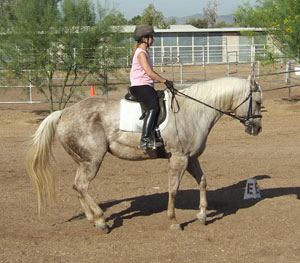
Yvonne and Kendra starting piaffe, September 2010
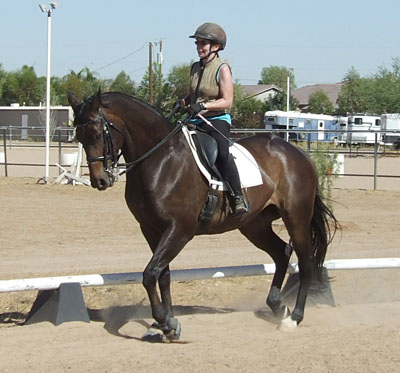
Yvonne and Belle starting passage, June 2010
In 2013 - We go BITLESS!!!! And then, no Spurs, too. Train, not Pain!
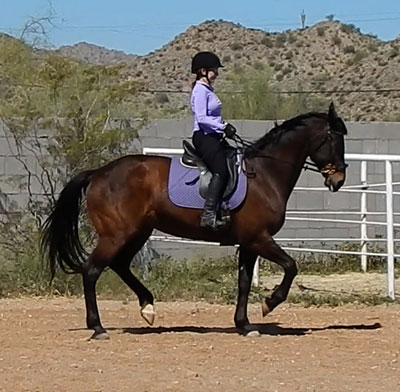
2015: Yvonne and Belle - passage in the Star Wheel Hackamore bitless-bit. Belle has made considerable progress in her passage and piaffe work since going bitless.