Your horse has laminitis and/or founder, and you are in a panic. What to do?
It might be hard at first for you to understand our answer: slow down and study. The key to helping your horse is your own self-education. We’ll give you some first aid tips here, but the total process will be long and slow, and full recovery might even take years—because most likely the laminitis/founder is merely a symptom of your horse’s overall poor hoof health. And that takes time and knowledge to fix. In other words, there are no quick fixes.
Let’s start at the beginning. Most people confuse laminitis with founder, or use the words interchangeably. We define the two ailments as very separate, though related, conditions. A good way to remember is that laminitis is acute, like getting a flu virus or food poisoning, while founder is chronic, like developing osteoporosis or diabetes.
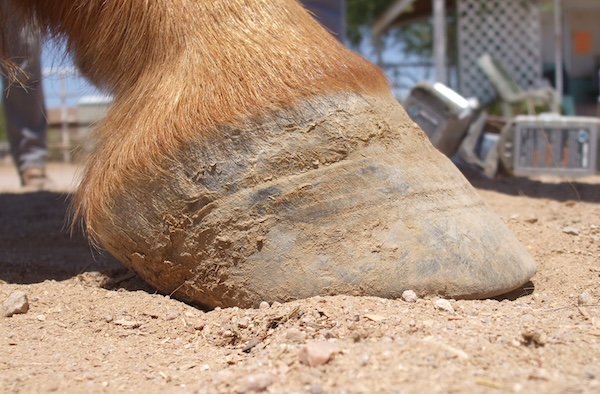
What is laminitis? Laminitis, by definition, is the inflammation of the laminae inside the hoof capsule. The laminae are the soft vascular tissues (laminar corium and the lamellae or sensitive laminae) that line the coffin bone and produce the laminar horn, which we see on the sole level as the “white line” of the hoof. Many people confuse laminitis with founder, or call founder by the term “chronic laminitis,” but we prefer to separate the two very different conditions. Laminitis is an acute condition, while founder is a chronic, long term condition. A laminitic hoof might not appear any different in form than a normal or “typical” hoof.
Laminitis can be compared to having a “fever” in the hooves. It is very painful, due to the tissues swelling within the hard horn. The symptoms are lameness, from mild to severe, and it usually occurs in all 4 hooves, though it often shows up much worse in the fronts. Lameness in just one hoof usually excludes laminitis. Many people look for a bounding pulse in the legs/hooves to determine laminitis; this may or may not be present, and can be difficult to judge on a particular horse. Likewise, many people will assess laminitis based on the warmness of the hooves; however, all healthy bare hooves are warm, so such an assessment may only be useful with unhealthy hooves (or shod hooves), unless you know that particular horse’s normal hoof temperature. If a horse is lame in both front hooves, especially if a suspicious event has happened recently (possible poisoning or toxin, severe illness, severe stress), then laminitis should be suspected.
Previously we did not believe that, outside of the extremely rare event of severe poisoning (such as the deliberate poisonings used in the some equine studies), the laminae would quickly detach due to laminitis. This was because we had observed so many cases of laminitis in fairly healthy hooves (due to illness), and there had been no lasting after effects, and no founder. Laminitis typically lasts from a couple days to a couple of weeks, and in a healthy hoof can pass with no long term issues. However, we have now observed multiple cases of extremely healthy hooves having immediate complete meltdowns after a common chemical exposure, so we are revising this into a strong warning. Be careful about the chemicals you put into your horse!
Any kind of laminitis can be very serious for the unhealthy hoof, and lead to the revealing of founder, which in that case is actually somewhat pre-existing.
Laminitis is not unusual; in fact, mild laminitis will probably happen to most horses at some point, no matter how healthy the hooves may be. However, in a healthy hoof, laminitis will usually come and go, in days or weeks at the most, leaving the hooves relatively unchanged, except for possible rings or ripples. In an unhealthy hoof, laminitis can push that hoof over the edge into serious founder.
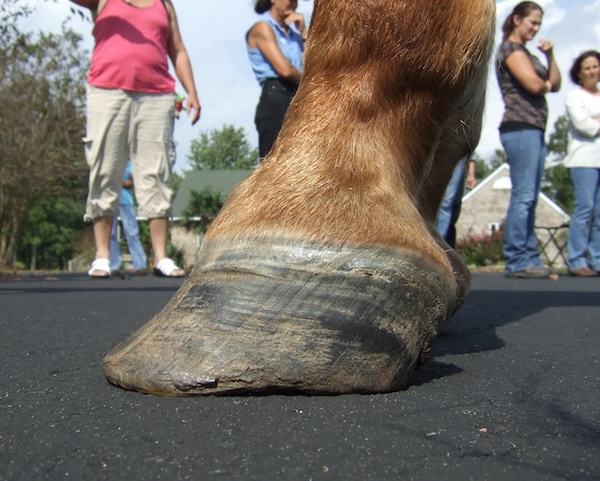
What is Founder? Founder is technically the mechanical separation of the coffin bone and its laminar attachment from the outer hoof wall. It is often called “rotation of the coffin bone.” In a typical scenario, founder is preceded by a bout of laminitis, and because the horse’s severe hoof problems have gone unnoticed up to this point, to onlookers it may appear that the horse has “foundered” overnight. Only now, after the horse’s acute lameness from laminitis, are x-rays taken of the hooves, and these x-rays show rotation of the coffin bone. It is often not known at what point the rotation actually occurred, but in many cases, the horse was probably rotating slowly for many years. Even if there was no pre-existing “rotation” (often only due to the lack of a flexible hoof capsule), there was pre-existing laminar damage. The inflammation of laminitis can also cause further rotation in the already stressed tissues.
We believe, from our studies, observations, and experiences, that founder is typically a mechanical problem (outside of chemically-caused incidents or horses suffering from severe metabolic issues). In most cases, the cause is poor hoof form that eventually destroys the laminar connection. Thus, founder happens slowly, over the course of many, many years. Eventually, a “straw breaks the camel’s back,” and acute laminitis occurs, but at this point, there is no way to undo the damage. If the damage is significant, with actual loss of coffin bone, the hoof will never be healthy again. If the damage is minimal, with the coffin bone intact, correct trimming can sometimes restore the hoof back to a healthier form—although most founders will never have truly “normal” hooves and will always be somewhat handicapped. Therefore, it is very important to have realistic expectations if ever attempting to rehabilitate a foundered horse.
The Symptoms of Laminitis
If you’re in a panic, most likely your horse has laminitis right now and is very uncomfortable. Laminitis is the symptom of pain which alerts the horse—and us—that there is an emergency situation going on in the hooves. Laminitis is usually caused by a change or a stressor upon the horse. This means that almost anything can indeed cause laminitis (feed change, trailering, toxic weeds, overeating, illness, injury, foaling, vaccinations, chemical deworming, anxiety, change of environment, herd member changes, hoof care changes, etc.)—and the unhealthier the hoof, the more easily laminitis can be triggered. Laminitis is less common in healthy hooves, but still happens in extreme situations.
Your horse may or may not also have pre-existing founder, which, as we described above, would have happened slowly over many years. There is no “rush” with founder–it’s already happened, and you simply cannot undo it quickly, so prepare for rehabilitation that might take years, or even the lifetime of your horse, depending on the internal damage. Nonetheless, the corresponding laminitis is a situation that needs immediate attention, as the inflammation can indeed make the founder much worse. The first steps are the same: a correct trim as soon as possible, to minimize damage, and a full evaluation of the horse’s hoof health and overall health, as well as removal of all possible triggers.
There are degrees of laminitis, each requiring a slightly different protocol. In every case, the most important thing you can do is to keep the horse trimmed as correctly as possible, with a strong focus on eliminating the peripheral loading so that the lamina can repair quickly (thus preventing founder). Here are the most common situations below – this assumes that the horse is under the care of a competent barefoot trimming professional, and the condition of the hoof and coffin bone health is known. (Note: this should not be interpreted as veterinary advice. Please seek veterinary advice as needed).
1) Extremely mild laminitis: the horse is just slightly ouchy when walking, but still very willing to move on its own. Usually this type of laminitis can be largely ignored, and can even be seen after initial trims which greatly change the hoof form and improve blood flow. Expect the horse to recover quickly in just a few days. Provide freedom of movement 24/7, and hand walk or ride at a walk (using hoof boots if that improves comfort), using the horse’s comfort level to dictate exercise amount.
2) Mild laminitis: the horse is mildly lame at the walk, and not really willing to walk on its own, but will walk with gentle encouragement. In this case, you can get a veterinary prescription for pain relievers, but try to limit the use of NSAIDs to 3 days duration, due to their side-effects. Provide freedom of movement 24/7, hand walk ONLY if the horse is willing to, and use hoof boots as needed for comfort. Mild laminitis will usually go away on its own in 3 days to 2 weeks, depending on the cause (usually longer for toxin-related events).
3) Moderate laminitis: the horse just does not want to walk at all, and is quite lame at the walk. However, the horse does not appear to be in severe stress when standing. Do not force the horse to walk, and seek veterinary advice for pain relievers and other support, with the goal of getting the horse to the point where he is able to walk comfortably. Provide freedom of movement 24/7, and use hoof boots as needed for comfort.
4) Severe laminitis: the horse appears to be unable or unwilling to walk, and seems to be in constant pain even when standing. Seek immediate veterinary attention. The real danger here is that the horse can develop additional problems from the stress of the pain (even organ failure).
5) Extremely severe laminitis: the horse is recumbent and in so much pain, he cannot stand. Of course, seek immediate veterinary attention.
What to do for Laminitis?
For every horse with laminitis, the key will be correct hoof form and reduced peripheral loading, along with as much movement as possible. If your horse has mild to moderate laminitis, there are a few other things you can do to help your horse right now:
• Icing or Cold Water soaking: Scientific studies seem to indicate that cooling down hooves is effective during acute laminitic episodes. Stand in buckets of ice water, or hose with cold water.
• Natural/Herbal pain relievers: Anything that is marketed as an anti-inflammatory can be very helpful. There are many herbal blends with Devil’s Claw and/or White Willow Bark that are quite effective. High doses of MSM (3 Tablespoons per day) can also be very anti-inflammatory. Likewise, try high doses of Vitamin C and Vitamin E, as well as Magnesium.
• Probiotics/Prebiotics and human-grade calcium bentonite clay: Especially for toxin-related laminitis, but really for any horse in stress (as well as a preventative), probiotics and/or prebiotics help with digestive stress. Calcium bentonite clay can also be fed to horses (or given as a paste) to soak up toxins.
• Homeopathic remedies: Though there is controversy about their effectiveness, they are a safe option to try. Use Bach Rescue Remedy to help with stress. Here is a common homeopathic protocol for acute laminitis: Aconite 200C should be given immediately, every 15 minutes for 4 doses. If there are throbbing arteries with a bounding pulse and sweating, Belladonna 200C can be given at the same time, every 30 minutes for 6 doses. If the laminitis was caused by a toxin (such as overeating grain), Nux Vom 200C should be given to relieve circulation congestion, every 6 hours for 3 days. Homeopathic Arnica can also be given as a general pain reliever.
• Hoof boots: Always keep hoof boots on hand for emergencies, even if you don’t regularly use them. If you have an assortment of boots and pads, all the better: in this case, let the horse tell you what feels most comfortable, and use that for now. You can’t really “protect” the sole to prevent pain IF the pain is due to internal pressure (such as in laminitis), but boots can provide great comfort and protect from external trauma, rocks and uneven ground. In a pinch, you can also cut out a foam cushion mat and duct tape to the bottom of the hoof. When leaving boots (or wrapping) on solid for 24/7, please make sure to monitor closely, due to the complications of retaining moisture in the hoof. It is best to schedule some time without boots, even if just an hour per day. Be sure to clean and inspect the hooves and boots thoroughly every single day.
What to do for Founder?
Treat the symptoms of laminitis as necessary. The founder will be corrected to whatever degree is possible simply with an excellent barefoot trimming protocol. A physiologically-correct trim works by improving the laminar connection, which helps the foundered hoof.
The most important thing you can understand is that, while every horse can (and probably does) get laminitis at some point in its lifetime, a horse will probably not founder unless the hoof form is incorrect (exception for when a severe toxin is involved).
What about pain relief for a foundered horse? This is complicated, as every pharmaceutical pain reliever comes with a high cost – not just money, but negative side effects. There are specialized farriers who will use glued on and nailed on plastic shoes to provide pain relief, and this can be a viable option. However, their overall effectiveness in the long term for a severe founder is hard to determine, as there can never be double blind clinical studies to prove which method of treatment works best. Every horse is a unique individual case.
Barefoot hoof care was originally popularized by early practitioners as a “miracle cure” for founder. That is simply not true. Thus, be skeptical of any supposed miraculous solution.
How to prevent Laminitis and Founder?
The prospect of preventing most founder is truly exciting, because once you achieve a fairly decent hoof form on your horse, founder is really not mechanically possible – and then the only concern is a very severe poisoning incident.
Preventing laminitis is a bit trickier, and sort of like the idea of preventing all colics. Caring for your horse more naturally will go a long way towards reducing stress—and stress is the number one cause of disease. Keeping your horses in herds outdoors, living outside a stall, feeding a more natural forage-based diet, etc., will overall help prevent laminitis. Strengthening the immune system and creating the healthiest hooves possible are keys. Healthy hooves will be far more tolerant of the types of stress that might cause laminitis.
Instances where laminitis can be difficult to completely prevent, depending on the horse’s susceptibility: ingesting poisons or toxins (which includes chemicals such as those in vaccines, deworming medications, and common equine drugs like corticosteroids); mares retaining placenta after birth; severe injury in one leg resulting in overstress of the supporting limb; severe illness of any kind, especially if the horse has a high fever and/or is recumbent. The healthier the hooves, the more positive the outcome. We have first-hand experience with several severely ill horses that should have developed laminitis or founder according to veterinary opinion, and did not, due to a healthy hoof form. But this does not prevent every toxin-induced severe laminitis that can lead to founder.
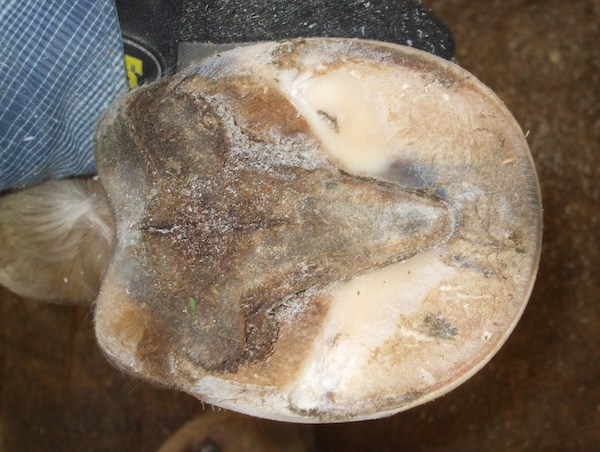
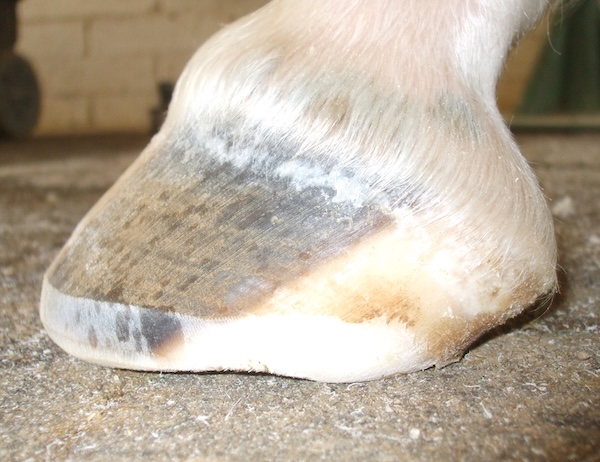
This hoof above (both photos) belongs to a German riding pony, only a year out of shoes, that became deathly ill from oleander poisoning. He was under intensive veterinary care for a month, and the vets fully anticipated laminitis/founder, which is a natural side-effect of the severe illness. His hooves remained unaffected, with no physical changes and no laminitis, due to the healthy form already obtained from only one year of good trimming. This is just one case of severe illness, but still provides a powerful testimony to the possibilities of an effective trim for laminitis/founder prevention.
If you are constantly battling recurring laminitis with a horse, besides scrutinizing the trim, make sure to evaluate the diet. A high quality vitamin and mineral supplement, or mineral balancing of the entire diet, can make a huge difference for many horses. Some horses are being fed too much grain or harmful fillers and preservatives, which can trigger reactions in some horses. Lush grass or certain species of grasses can cause problems for sensitive horses. With a problem horse, you might need to simplify the diet as much as you possibly can, to rule out dietary triggers. Also scrutinize any environmental toxins, such as those hidden in the water supply or terrain/dirt. Also, please evaluate your horse for metabolic issues.
We should note that horses with serious diet issues directly causing their laminitis (or other problems) are not quite as common as one would expect: in many cases, horses will be drastically improved through better hoof form alone (though we strongly recommend improving the diet, too!) In the end, if the trim is never fixed, a horse with poor hoof form is still going to have poor hoof form even after that diet makeover—that’s why the trim comes first, for mechanical reasons, and then we scrutinize the diet.
It is very frightening to have a horse that suddenly develops laminitis or founder, but in the end, our goal is to prepare you to never be surprised by such an event. Most cases of laminitis and founder are largely preventable with the simple knowledge that we share with you. A foundered horse should never come as a surprise to anyone; you should be able to see it years before it happens (and you can also prevent it at that time!). Laminitis should be an expected possibility with any extreme stress, illness, or injury, but should not be a terrifying, chronic, “mysterious” disease. Healthy hooves, once again, are the simple solution.
By James and Yvonne Welz, published 2023 Hoof Help Online
ECIR – the Equine Cushing’s and Insulin Resistance Group
This is a priceless website for owners of horses with laminitis and metabolic issues. Includes detailed instructions for diet and trimming to help get these horses’ hoof problems under control.
https://www.ecirhorse.org
See the full content listing of all issues of The Horse’s Hoof Magazine! We also provide instructions on how to read the issues for free on Hoof Help Online.
For a detailed listing of all articles on The Horse’s Hoof website, please visit our Article Directory.