Have you heard anyone say recently, as an argument against barefoot, that they “have to shoe” their horse? Or that “some horses must be shod?” Have you been either irate, or tongue-tied, when you attempted to reply?
In this article, I hope to shed a little light upon what those phrases actually mean. We’ll explore why people say that, and what those statements may actually say about them. And in the end, hopefully everyone ends up tolerant and respectful of one another.
First a disclaimer: I am a big believer in personal and individual freedom. As an American, I strongly believe that all people have the right to choose what to do with their own personal property – which includes horses. Whether I agree or disagree, what people do with their own horses (and cats and dogs and children, for that matter) is their own business.
I am also not opposed to shoeing horses, per se, though it is something that I, personally, choose not to do. I will readily admit that there are situations out there where a horse is better off with shoes on. This is not an agreement with the concept of shoeing, but rather an acceptance of the reality of a horse world which puts the needs of humans before the needs of equines. Since riding itself is an unnatural act, there can be no argument there.
And there are some people who really don’t care what’s best for the horse; horses have long been “vehicles” for humans. Not everyone shares in the spirit of the horse—some are interested only in the mechanics, in the physical body. The horse is simply a breathing 4-wheeler. For those who use the horse as a tool, device, or vehicle, shoes will continue to serve their needs well. However, I believe that the vast majority of horseowners, as well as their vets and farriers, are honestly just trying to do what they think is in the horse’s best interest.
What I am opposed to is someone not taking responsibility for their decisions. For instance, saying that you “must shoe” your horse takes away all your decision making opportunities. You then have no choice to make – you simply “must” shoe, and there is no option. Frankly, it’s a cop out.
If someone tells you they “must shoe” their horse, make sure to ask why. Chances are, what they are really saying is that they do not want to bother themselves with learning how to barefoot their horse – or have to face up to their own horse’s severe hoof pathology. It is too much trouble for them to learn about the physiologically correct hoof form and the biological needs of an equine. If they readily agree with those statements, fine – as long as they are consciously aware of their decision! And we, as barefoot horse owners, must respect their personal decisions – just as we ask shod horse owners to respect ours. However, if in the same breath as “have to shoe” they also describe it as “what’s best for the horse”… then you might need to point them in a new direction. Shoeing is best for humans – not horses, end of story. One need only to look at horses’ successful survival without shoes for millennia to confirm that.
Further, it is an entirely different matter when someone uses the “must shoe” argument to give advice to horseowners, or to criticize the act of barefooting horses at all. What does a “must shoe” statement say in this situation? Sadly, it shows a huge lack of understanding, especially disheartening when it is a person in a position of authority or accomplishment. It can mean that the person speaking lacked the knowledge and skill to be able to barefoot their own horses successfully, and so their own unsuccessful experiences make them determine barefoot simply cannot work for anyone.
It can be a person’s attitude alone that opens or shuts the doors in life: if you believe you will fail, you will. If you believe barefoot cannot work, it won’t – for you. Some people are at a point in their lives where they simply can’t accept new traditions or ideas – “my horses have always been shod, and dangit, they always will be!” Many people’s lives and experiences have been filled with the tradition of shoeing horses, and they cannot accept that it may have been detrimental to their horse’s health.
Lameness and death in teenaged horses is so common now that it is taken for granted – with no consideration given to the price they paid for protection of hooves via iron shoes, or the long term health costs of convenience stalling. Yet any sensible person will readily agree: yes, it is better for horses to be barefoot. Yes, it is better for horses to live outside with room to move. What we ask is only that people acknowledge and take responsibility for their horse keeping practices. There are ways to make horses’ lifestyles better, even for people who “have to shoe!”
For all the people out there who own horses for the love and joy of these magnificent animals and are seeking a life-long partnership, the option NOT to shoe becomes very obvious. Why does anyone ever “have to shoe” their horse? Since no horse was ever born with shoes on, and shoes are a man-made object, we therefore decide to shoe horses. Someone who says they “have to shoe” their horse is really saying that they choose to shoe their horse.
If owners really want what is best for their horse, they are well-advised to seek out more information about hoof care and all the alternatives available for hoof protection. The principles of good horse care and hoof care are universal! Owners need to find out the details of how to keep their horses sounder, even if they are determined to shoe—such as periodic breaks from shoeing, frequent resetting, non-concussive shoes, healthier living conditions, etc. If they feel they “have to shoe” because they compete in a certain sport, they will be surprised to learn how many barefoot horses are now competing in various disciplines. If owners think they need shoes for protection of the hoof, there is now a huge variety of hoof boots flooding the market. Anyone can easily find healthier and safer forms of hoof protection, and these hoof boots take away most people’s excuse NOT to go barefoot!
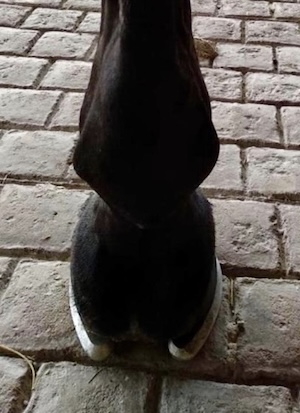
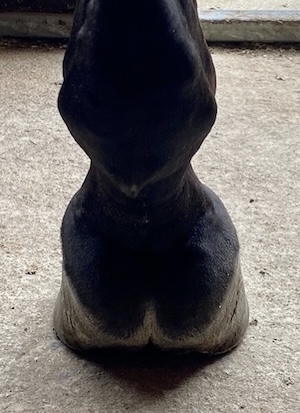
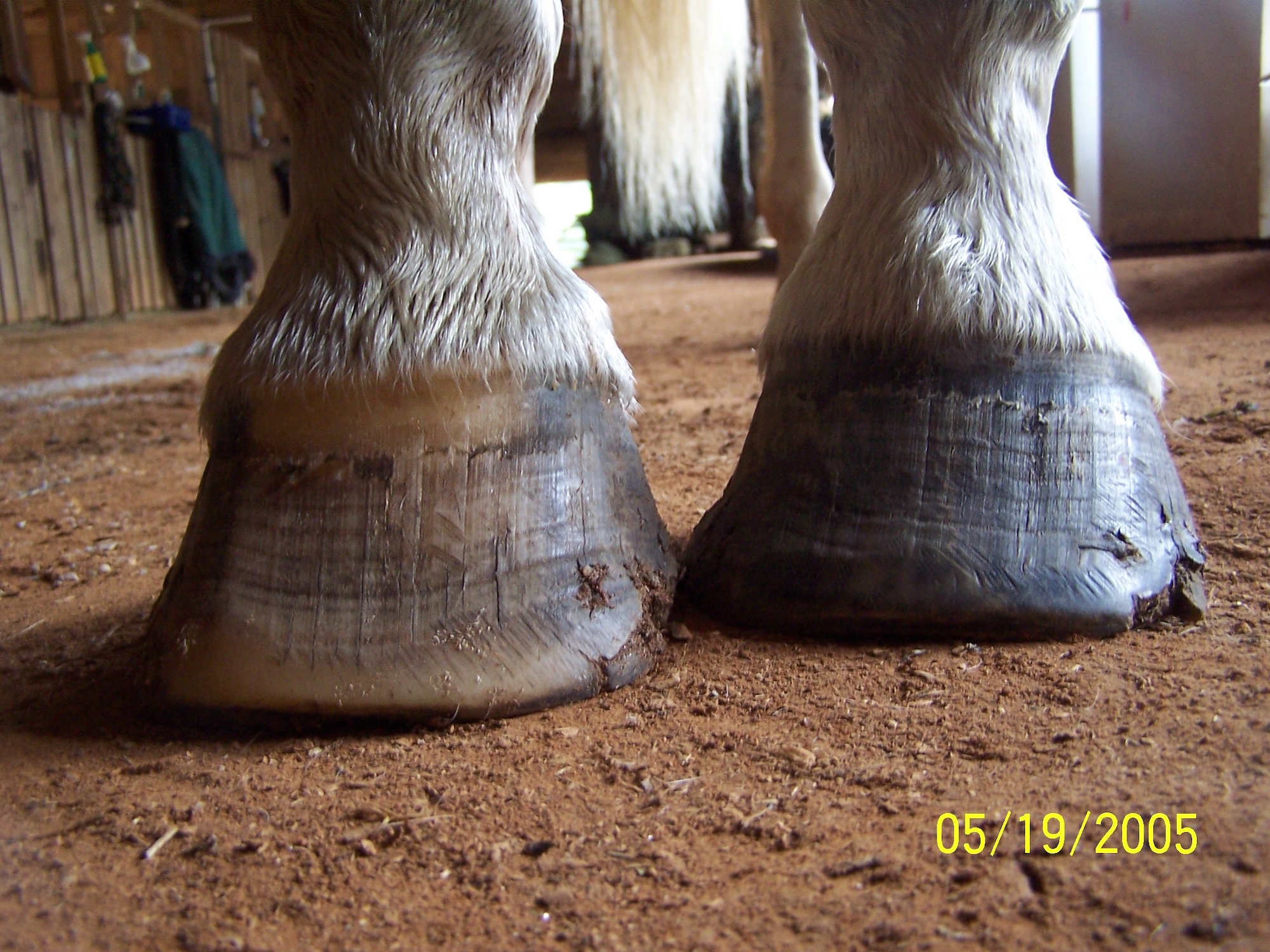
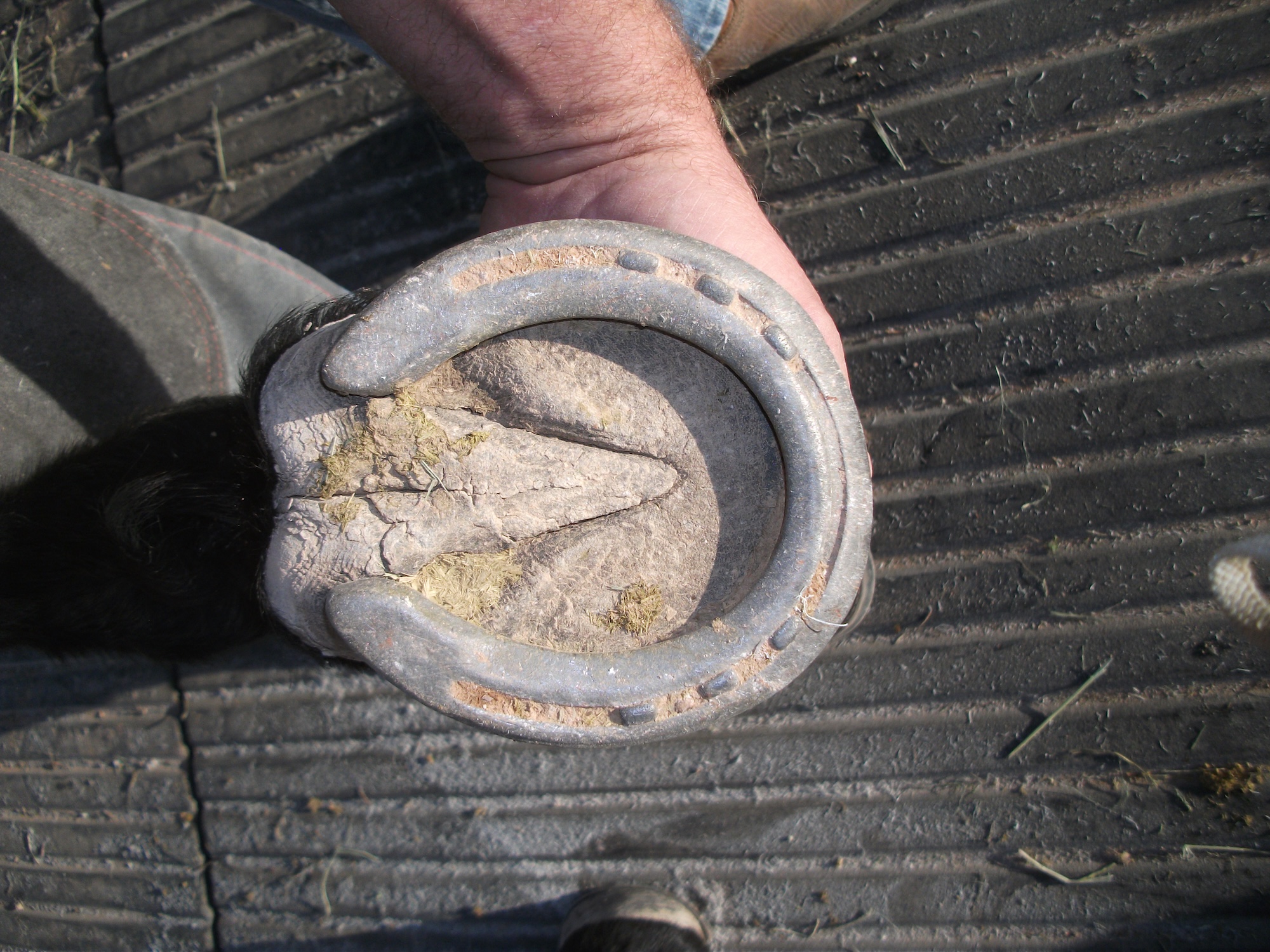
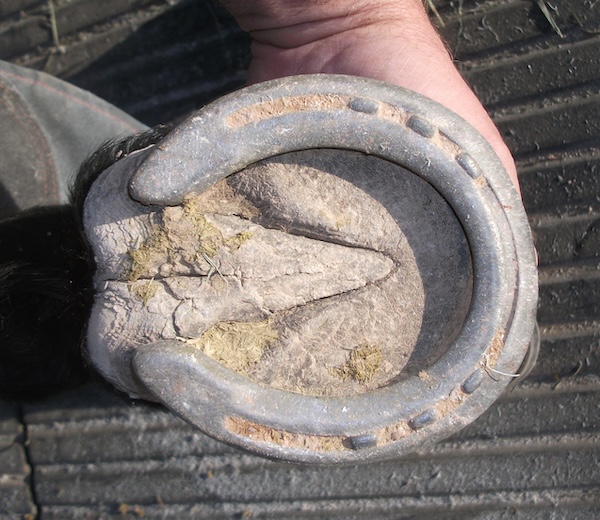
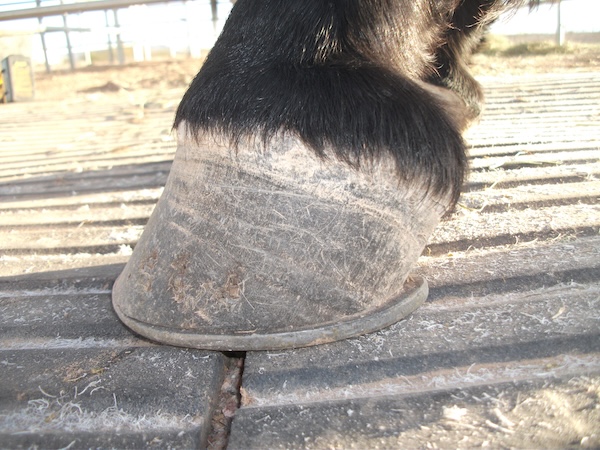
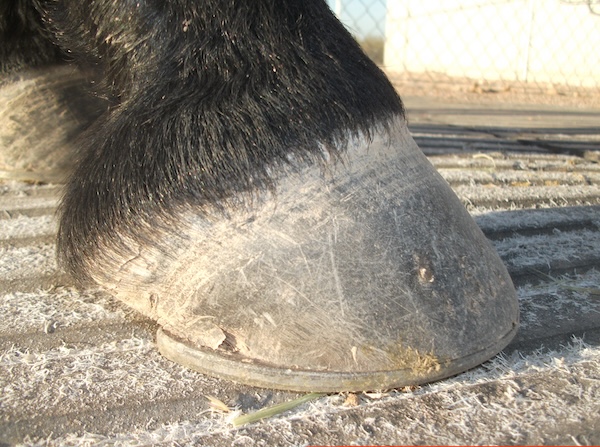
Here is the same mare four months apart, shod compared to barefoot. The spread of the hoof is shocking! Heels are supposed to be wide and supportive for the entire foot and leg of the horse. Photos courtesy of Martí Sala Bayés, a European farrier who endorses barefoot, as much as possible, for hoof health. He is also an eventing rider himself, and was the official farrier for the 1992 Barcelona Olympics. He is now asking the sporthorse world to consider utilizing barefoot as a tool to aid in creating better hoof health, even for the elite shod horses of upper level performance. He calls this, “Interval Barefoot.”
What about the argument that “some horses must be shod?” Unfortunately, the answer here is disheartening, because when a horse is seriously lame after shoes are removed, it means that significant damage has already occurred in its hooves. It is truly a sad statement for mankind’s care of the equine in captivity when a horse cannot walk on its own feet. Therefore, any horse that is kept shod because he is severely lame without shoes is a very sick animal already, and it is only a matter of time before he will be lame with the shoes on, also.
It all goes back to improper living conditions and improper hoof form – and we, mankind, are to blame for this. Take responsibility for your decisions! If you choose to keep horses that “must be shod,” please acknowledge that the way you have cared for these horses has been detrimental to their health, and now they have lost the function of their own feet. We did this to them—and it is up to us to undo it. Or better yet, let’s just prevent this scenario from happening in the first place—leave our young horses barefooted, and keep them that way!
Horseowners everywhere have put into action improved methods of horse care, and more knowledgeable forms of hoof care. There doesn’t need to be arguments over “who’s right” and “who’s wrong”—we can all improve upon the care of our horses in captivity. We can continue to learn from one another, develop new techniques, and help ensure that tomorrow’s horses, whether shod or barefoot, will lead healthier and more natural lives.
by Yvonne Welz, published in The Horse’s Hoof Magazine, Issue 68, Fall 2017, originally published as “Examining the ‘Have to Shoe’ Argument”
For listings of Certified Barefoot Trimmers, please visit our Barefoot Resources page.
See the full content listing of all issues of The Horse’s Hoof Magazine! We also provide instructions on how to read the issues for free on Hoof Help Online.
For a detailed listing of all articles on The Horse’s Hoof website, please visit our Article Directory.