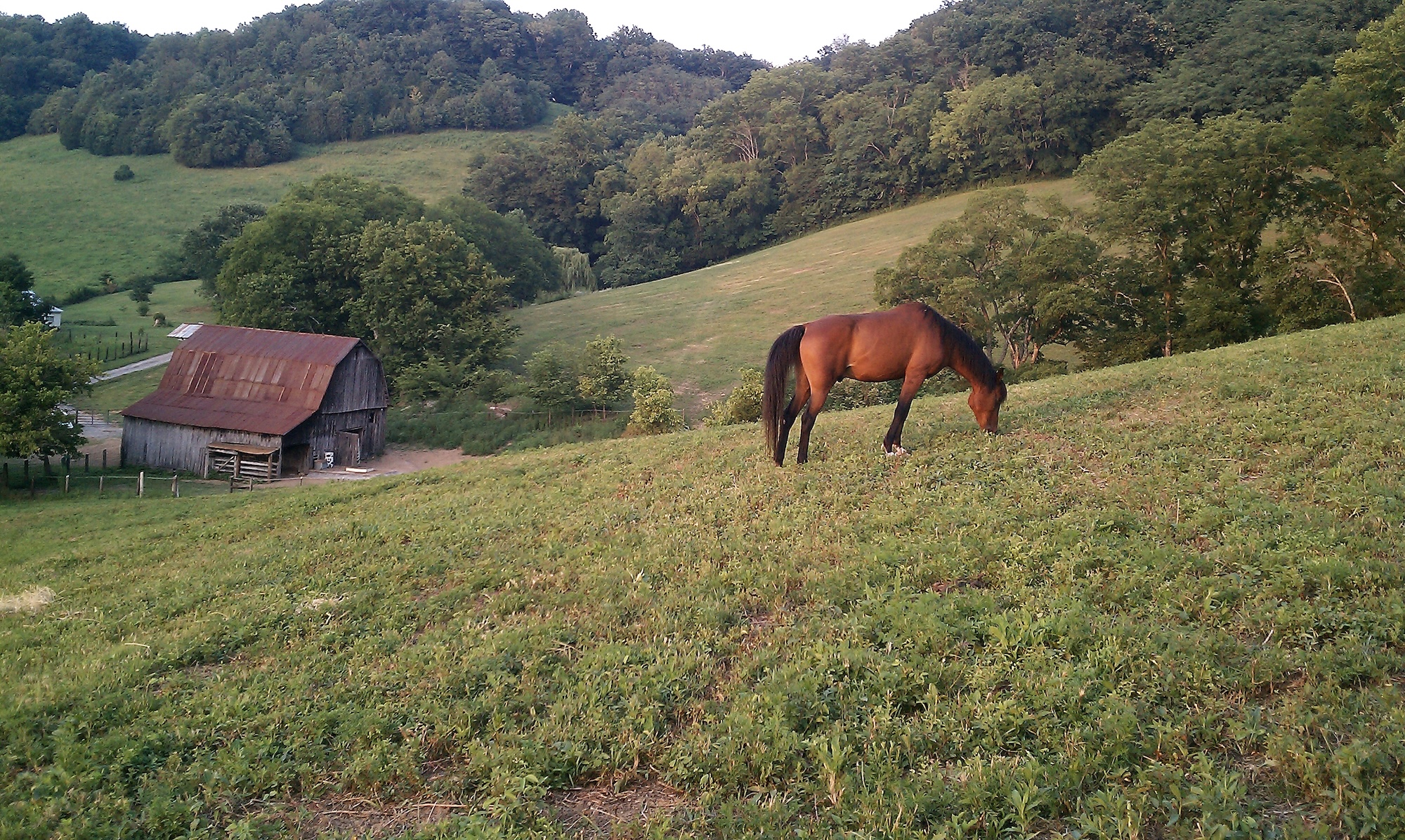
Editor’s note: Joe Camp, author of the national best seller The Soul of a Horse – Life Lessons from the Herd, and his wife Kathleen moved with their six horses from the high desert of southern California to the green hills of Tennessee in 2009. Joe was an outspoken advocate for barefoot horses and committed to keeping their herd out 24/7, even though they were being warned not to do so on the rich grasses of middle Tennessee. This article was adapted by Joe for The Horse’s Hoof from his book The Soul of a Horse Blogged – The Journey Continues, and provides inspiration for horse owners who wish to allow their horses to graze safely. All photos courtesy of Joe and Kathleen Camp.
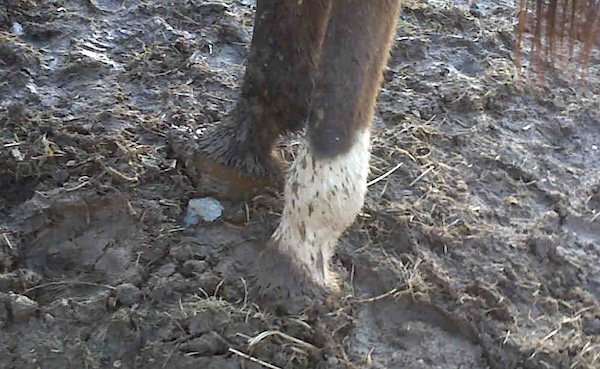
Our timing was perfect. The move from dry rocky southern California landed us right in the middle of record-setting rainfall in Tennessee. Seven inches the day the horses came in. And it rained for days prior to their arrival. Gail Murphy’s Personalized Equine Transportation Service has a reputation for never being late, but on this day they were. The rains slowed them to a crawl causing them to arrive after dark. Which is when we learned that the turn onto our road was too tight for their rig to make. We had to shuttle the horses off the transport trailer onto our 3-horse trailer which had to be pulled by a generous new neighbor with his 4-wheel drive tractor because my truck would’ve been mud-bound for sure.
Noelle, our new mustang, went into a paddock in front of the barn, and the hillside herd of five got the paddock behind the barn for the night. We didn’t think it wise to turn them out on a steep unfamiliar muddy hillside at night. Is that another one of those human things like blankets in the snow :). They hadn’t been out of the trailer for ten minutes when every one of them began to wallow in the mud like little pigs.
And through it all, I could only think about what all this wet and mud might do to their beautiful, dry, rock-solid barefoot hooves.
Everyone was in fine (however muddy) shape the next morning. Noelle, our mustang who had not been with the herd as yet, was thoroughly enjoying being just over the fence and everybody seemed quite relaxed for being in such a strange place, after travelling more than 2000 miles across the country.
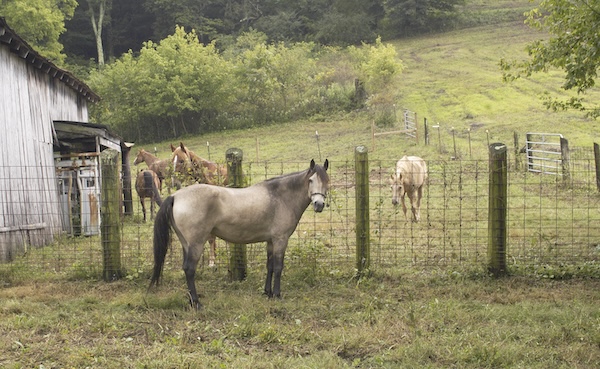
We checked the footing on the smaller of the two pastures, the one closest to the house, and decided to open the gate and let ‘em have at it. It was definitely an YeeeHaaww moment. Cash, my co-author and cover boy, trotted through the gate and without ever looking back, broke into a full run up the steep hill and off toward the house. Within moments, the other four were right behind him. Running, romping, and kicking up their heels! Kathleen got it all on video but no stills unfortunately (see The Soul of a Horse YouTube Channel). It was something to see. Poor Noelle could only hang by the fence and pace. And bellow at them.
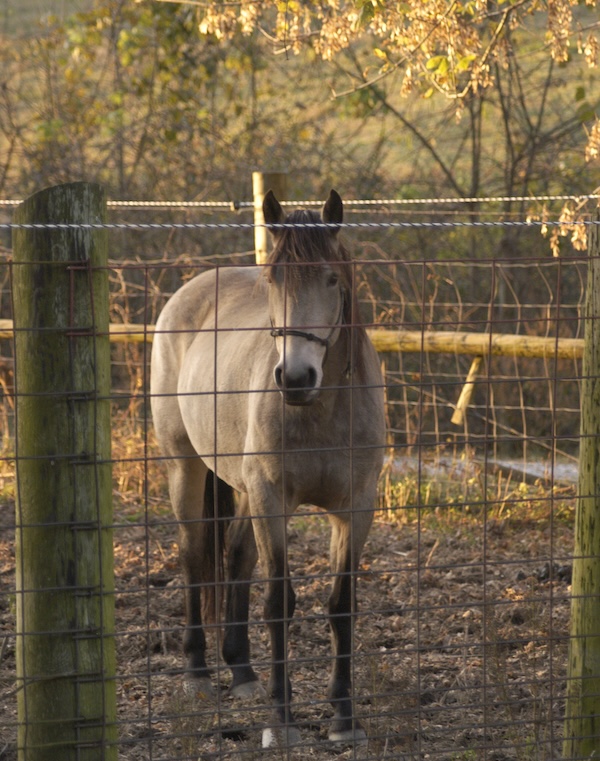
When the herd finally calmed down, their joy escalated into disbelief. There was grass everywhere! I’m pretty sure that four of the five had lived their entire lives in the west and had never seen anything like this. They were fun to watch, but it was also more than a little bit scary. We had received numerous warnings that horses could not come here from the deserts of southern California and be out 24/7 on the very “rich grasses of middle Tennessee.” Too much sugar in this grass, we were told. Some had called the area “Founder Valley.”
I was worried about it to be sure, but I had done enough study of horses in the wild to feel that something was amiss with the local logic. It’s more complex than just sugar in grass. All grass everywhere in the world generates sugar. Can soil alone cause an over abundance? And how much does lots and lots of movement play into digestion and metabolism? Can supplements balance other things that, if left unbalanced, would be bad for the horse? And how much can stress from confinement and human-adjusted lifestyle play into metabolism imbalances. I didn’t know, but I was already researching to find out. One of the points of moving here was to be able to truly let the horses live like horses. Like they were genetically evolved to live. And I wouldn’t give that up without knowledge certain.
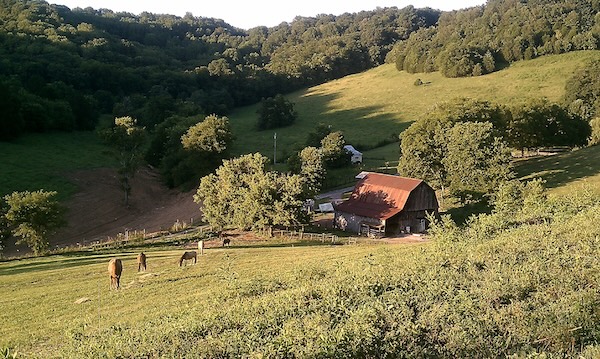
I was reminded of a piece I had read in a book about the San Diego Zoo’s adoption of two gorillas they wanted to mate. They fed the exact same leaves the gorillas had been eating in the wild, or so they thought. But the gorillas did not do well and did not mate. After a bunch of further research, they finally discovered that when they were washing the leaves (so they’d be nice and clean) they were removing all the little bugs and microscopic life that were actually adding 10% to 15% animal protein to the gorilla diets. They quit washing the leaves and the gorillas got better immediately, and mated.
So I was on a mission to “find the bugs” so to speak. To discover why horses in the wild can spend their entire spring and summer on beautiful rich-looking meadows and do just fine, but horses (or at least some horses) in middle Tennessee can’t. The answers I found made an interesting study into the way we humans think.
The first thing I discovered was that just when you think you have everything figured out, God says, “Not so fast”. We simply didn’t count on moving into record rainfall. And tons of mud in the pre-selected morning and evening supplement feed zones. I’m glad the washer and dryer were immediately hooked up, because I was sliding through a pair of muddy jeans a day! God just wanted us to know, after so much complaining about the dust in California, that the opposite of dust has its downside as well :).
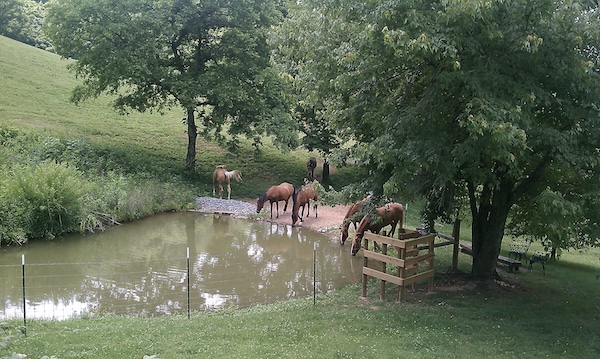
All the horses learned right away that water was now from a pond, instead of a big metal tub. Skeeter immediately got into the swing and went almost up to his knees. Even Cash who especially hates mud drank his fill, and it wasn’t long before Mouse leapt in belly first.
It turned out to be the wettest fall on record in middle Tennessee. We had over 26 inches during our first six weeks.
I was worried about their feet in such squishy conditions but that worry was trumped by the rich grass warning. I had to solve that issue. I had to find those bugs. I had already learned that wild horses don’t founder on grass. And some domestic horses do. And I was determined to find out why. Like the earlier story of the two gorillas at the San Diego Zoo, there had to be answers. And the logical place to begin is out there where there is no human intervention. Where no one is washing the bugs off the leaves. Out there in the wild.
During our first tele-workshop on Why Barefoot? we drifted into the role that diet and nutrition play in the barefoot lifestyle (huge!), and there was much talk about Spring grasses, high sugar content, etc. After the workshop, I was glancing over some of the questions from participants, and Ginger Kathren’s PBS series of “Cloud” documentaries that follow one particular wild herd in Montana’s Pryor Mountains came to mind. Every Spring, once the snow has melted enough, the wild horses head for a beautiful huge meadow on top of the mountain, staying there for most of the Spring, Summer, and early Fall. So I asked Eddie Drabek (natural hoof specialist and one of our workshop hosts): “What’s the difference? If Spring grasses are not supposed to be good for horses, then how do these mustangs get by. How do they deal with it? To our knowledge none of them have ever foundered because of the Spring/Summer grasses.”
Eddie’s answer was, I thought, brilliant. Loaded with super information, analysis, and a road map of questions for further research. It follows. The bold emphasis is mine.
“In the wild the grasses are native grasses…and unstressed grasses. Of course I realize there are times of drought but typically grasses left in their natural state handle such things quite well because they are going through the natural cycle they are meant to go through. They’re never mown down (other than naturally grazed, over time, each year), never overwatered, with no pesticides or chemical fertilizer, and not encouraged to grow in a season they aren’t meant to. Also the wild horse meadow is not just one kind of rich lush “genetically improved” grass, like all Orchard, or what not. It’s a mix. The horses have CHOICE. And the wild area is not lush and thick. Compared to many domestic pastures, wild meadow grasses are fairly scattered, which would help slow grazing and create more browsing…which helps the digestive system handle things more efficiently.
“Some native species of grasses are rich, others are not. And these “non-rich” grasses with lower starches/sugars can cut or dilute the sugar of the richer grasses.
“Every spring I see changes in my horses hooves…some rings, maybe they lose a little concavity here and there. Not enough to make them sore but I keep my two founder-prone ponies drylotted or they would show more damage. Why? Because our grass pretty much stays stressed. We have nothing but bright green little nubs of “candy grass” as I call it, since the pasture is overgrazed…I have too many horses on too small of acreage, so not much I can do other than keep them penned up the majority of the time, which I hate doing of course.
“I trim for a few clients who have large 40-50 acre pastures, with just 4-5 horses and tall healthy grass. A small few will show some minor changes but the majority have no problems at all. At least the ones not being fed sweet feed. That’s because the grasses are healthy, and non-stressed, thus much lower in starch/sugar. And typically on larger acreage there are a lot of native grasses, not all one type as in small paddocks.
“Mustangs start to drop weight in the fall typically, after getting a great weight during spring/summer. This is as nature intended. They get lean after a hard winter with less forage, and what forage is there is dry and dormant. Then spring hits and the horses are more able to handle spring grasses because they need it coming out of winter. Many of the mares are in final stages of pregnancy, they definitely need it to get ready for baby. If they started out being fat and chunky after winter and were put on the spring grass this might be a much different scenario.
“Most domestic horses don’t need the rich grasses to “come out of winter” the way a wild horse does, which is why it can cause them issues. We keep them fed and fat through winter… and panic if they do drop some weight. What’s worse…we keep feeding them the same exact amount of grain/feed, alfalfa, etc. we were feeding through winter, PLUS now they are getting grass. I tell people all the time, if they are getting a lot of grass, you MUST cut back on everything else (really they probably need nothing else). But people still feed…asking them to quit feeding pellets or grain I’ve found is like asking them to give away their first born child. They look at you like you are plum crazy.
“Also, there’s movement in the wild. The mustangs are getting a lot of movement. A lot! This helps so much; is necessary! They aren’t being confined, they have good firm ground. They aren’t living on soft shavings or arena sand part of their day, aren’t getting grains, sweet feeds, or alfalfa, etc.
“And here’s something most folks never think about: Domestic horses, particularly those that are stalled during part of the night/day, tend to gorge when let out on pasture, even when it’s baking hot. Their inner clocks are amazing…they know when it’s about time for them to be caught up and taken back to their pen or stall and they’ll begin to “gorge” when they know that time is running out.
“Nothing has changed more in natural hoof care than the diet info. The trim is the same, but diet thoughts change each week it seems. For instance now many are questioning Soy, and this is what they hoped would be a safer alternative to alfalfa/corn based feeds. It is definitely something I wish more people would research…and quit researching in the labs of Purina and Nutrena, and research extensively in the wild habitats…what we could learn would be fantastic.” – Eddie Drabek
As Spring began to flower in Tennessee and little green nubblets of grass began to come alive, I was once again reminded by several people that our horses shouldn’t be out 24/7 on the “rich grasses of middle Tennessee.” These warnings ramped up my motivation to find answers to the puzzling question of why some domestic horses founder on grass. I was on a mission to prove or disprove Eddie’s hypothesis.
First, I reviewed my list of Undeniable Truths developed for our two tele-workshops on Why Barefoot and Diet and Nutrition. These are known and proven truths of science, not conjecture or opinion. The ones that apply to this issue are:
- Science confirms that it would take a minimum of 5000 years – probably closer to 10,000 – to even begin to change the base genetics of any species. In other words, a few hundred years of selective breeding has no effect on base genetics whatsoever. Which means that the domestic horse and the horse in the wild are genetically exactly the same.
- DNA sequencing was performed on bones of horses discovered in the Alaskan permafrost dating 12,000 to 28,000 years old and the results were compared to DNA sequencing from today’s domestic horse. There was less than 1.2% difference between the two. Again confirming that the genetics of every horse on the planet are the same, and that “every horse on the planet retains the ability to return successfully to the wild or feral state.” Note the scientists use the word: successfully. In other words, today’s domestic horse has the genetic ability to grow as perfect a foot and take care of himself with no help from humans every bit as well as those in the wild.
- The horse evolved for more than 50 million years in the Great Basin of the western United States. During those millions of years he developed genetics designed to survive and live in a specific lifestyle in a specific manner. To eat in a specific way. To move a specific amount. To socialize in a way that provides for a specific need. The domestic horse of today retains those genetics which program his lifestyle to:
- Move a minimum of eight to twenty miles every day of his life in search of food, water, and staying ahead of predators. Living in a stall without this movement causes physical and mental stress to the horse.
- Eat tiny bits of forage – mostly grass forage – little bits at a time, virtually around the clock; a minimum of 16-18 hours a day, or more. Their tummies are tiny and not meant to eat two or three large meals a day, and their hindgut requires the constant passage of grass forage through it in order to perform and digest as designed. In other words, the horse needs free choice grass forage or grass hay 24/7.
- Live within a herd. For safety, not for fun. There is safety in numbers. Separation from the herd creates emotional stress, and emotional stress attacks the physical body, and bad things happen.
- Have the dietary choices available to keep themselves healthy and strong. A horse’s genetics know what the horse needs and when. For example – when a horse needs a liver cleansing, the brain will send him after thistle. When he needs vitamin E, it might send him searching for a blackberry. Etc. If he’s eaten quite enough of high-sugar grasses, the hypothesis is he’ll switch to the low sugar grasses to balance. When humans attempt to perform these functions, it’s usually pure guesswork, and usually late, behind the curve.
I sat on the porch and pondered these for a while. Clearly, the more the domestic horse could live and eat like his wild counterpart, the healthier and happier he would be. We had a pretty good start at this in California with our “Paddock Paradise” arrangement. They were never confined, were out 24/7 with the herd, and getting plenty of movement, defined by placing their hay in more than 100 small piles all the way around their 1½ acre hillside pasture. (See our Paddock Paradise video on The Soul of a Horse YouTube Channel) Not what you would typically call a pasture. There was no grass. Just dirt and rock… and dust!
But had we been able to add grass, it would’ve been a microcosm of how horses live in the wild.
Or would it?
At the time, I didn’t know how or what horses eat in the wild. I assumed that grass was grass. Off to Google, landing on safergrass.org and a study of What Feral Horses Eat by Kathryn Watts.
Ahhh. Now we’re getting somewhere.
Her study and several others found on the internet were pretty much the same, varying only by geographical availability. The conclusions were that wild horses eat mostly (80% or better) native and naturalized grasses of various species plus orbs (flowering plants and weeds), shrubs of various kinds, tree leaves and bark, and more. In other words, they have lots and lots of choices and they use them. Ms. Watts found that all the grasses in the wild contained lower sugars than any cultivated pasture grasses she’s tested. And some of the wild grasses contain substantially less sugar than domestic pasture grasses. Thus, the hypothesis that the wild horse will balance his own sugar by eating both kinds of grass, along with those orbs, shrubs, tree leaves, etc.
She also points out, as does Pete Ramey, that grasses in the wild tend to be “bunchy” or “patchy,” not in thick, tightly-woven carpets like so many domestic pastures. So the horse in the wild has to move more, cover more ground, to get the same amount of forage that a domestic pastured horse is getting. The wild horse is getting less grass per acre, thus less sugar per acre. And more movement, which helps digestion and circulation. Plus he’s balancing his intake by what his body is telling him he needs. And he has a wide range of choices of forages to accomplish this as he goes about his day.
I was beginning to carve away at the answer. Only it was obviously not one “answer,” but a whole bunch of answers.
We all want this to be simple, but like so much of life, it just isn’t. There is not one big difference between the domestic pasture and the wild horse meadow that can solve the sugar problem. There are a lot of differences, and each one is important.
Yet the bottom line is simple. Replicate the wild horse lifestyle and diet as closely as your situation permits and you will likely be good to go. And your horse will thank you.
After digging into this for a while now I think I’ve found “the bugs on the leaves,” or rather they have become self-evident, and there are a bunch of them.
Ready?
Here we go:
First, most grassy domestic horse pastures are:
- Only a single species of grass and nothing else. No orbs, or shrubs, or weeds, or trees. Nada. One choice for the horse. Eat it or go hungry.
- That single species of grass is usually a “cool season” grass like orchard or timothy because they grow longer into the cooler seasons. Cool season grasses are much higher in sugar content than “warm season” grasses because the cool season grasses contain fructan. Fructan that can continue to build forever as long as there’s sun for photosynthesis. Warm season grass contains no fructan, only starch. Starch that is self-limiting because once the organ that holds it is full, production stops. Kathryn Watts has found cool season grasses to have NSC (sugar) percentages as high as 25+%. Warm season grasses are much, much less. The generally accepted NSC maximum as a percentage of a horse’s overall diet should be 10% or less.
- That same single species of grass is usually a genetically modified species to make it heartier and grow longer into the cool seasons. Kathryn Watts’ studies find that genetically modified and “improved” grasses are consistently higher in sugar than any natural or unmodified species.
- The single species of grass in a domestic pasture is usually heavily fertilized with chemical fertilizer (to make it even richer, and thicker). Chemical fertilizer contains large amounts of potassium which in times of stress can be feeding the horse levels of potassium a thousand times the amount he should be getting. This can cause all kinds of internal problems.
- The single species of grass in a domestic pasture is also probably sprayed with herbicides to kill everything except the grass (plants and weeds that might be giving the horses some of the choices he needs). Note: Chemical poison of any kind, regardless of manufacturers’ claims, is not good for the delicate balance of the inner workings of the horse’s gut.
- The single species of grass is also probably sprayed with pesticides from time to time. Another poison.
- And, lastly, the soil itself can be worn down and depleted of needed nutrients etc when planted and replanted with only the same seed every year, and fertilized and re-fertilized exactly the same, year after year.
So I suppose if you’re looking for one big issue to hang your hat on, it would be the issue of choice for the horse. Lots of choices. Not just one species of highly fertilized cool season grass. But rather many species of grasses, favoring low sugar warm season grasses like Bermuda, and lots of other stuff. All scatter-planted in patches and bunches. Not wall-to-wall. I cannot emphasize enough that if your horse has the choices he needs, he will make the right choices to balance his diet and thus himself.
The perfect natural pasture for the horse will be ugly. Big time ugly. It will look uncared for. Not a nice, beautiful, thick carpet of a single species spreading out for acres.
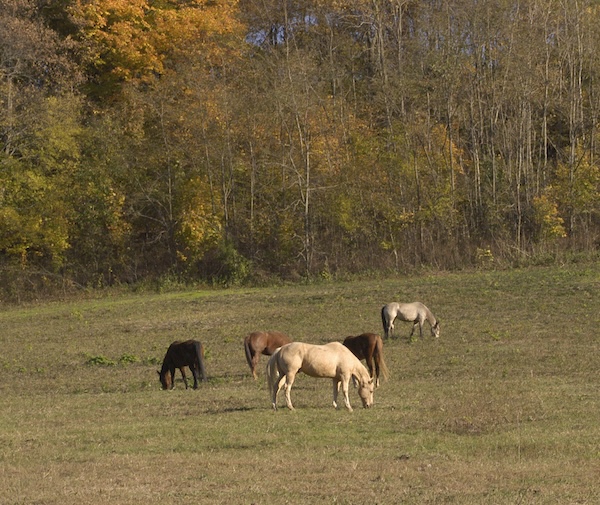
Below are two of Ginger Kathrens’ photos of the wild horse meadow atop one of the Pryor Mountains of Montana where Cloud’s band and many other wild horses hang out during the Spring and Summer. They head up as soon as the snow melts and don’t go down until they’re forced to by the onslaught of winter weather. From a distance, it looks for the world like any cultivated rich green pasture, but it’s not even close. The horses have tons of choices to balance their own diets and apparently handle it all quite well.
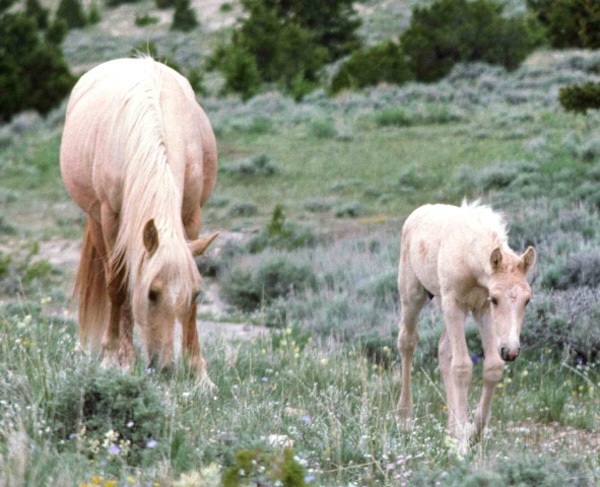
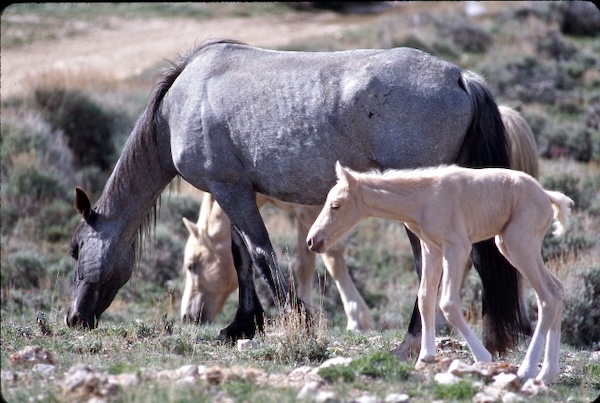
Not your pristine, manicured pastoral scene you would expect to see driving through Kentucky, or even our little slice of middle Tennessee. As I said, wild horse pastures are ugly with a capital “U” but are just what the horse needs.
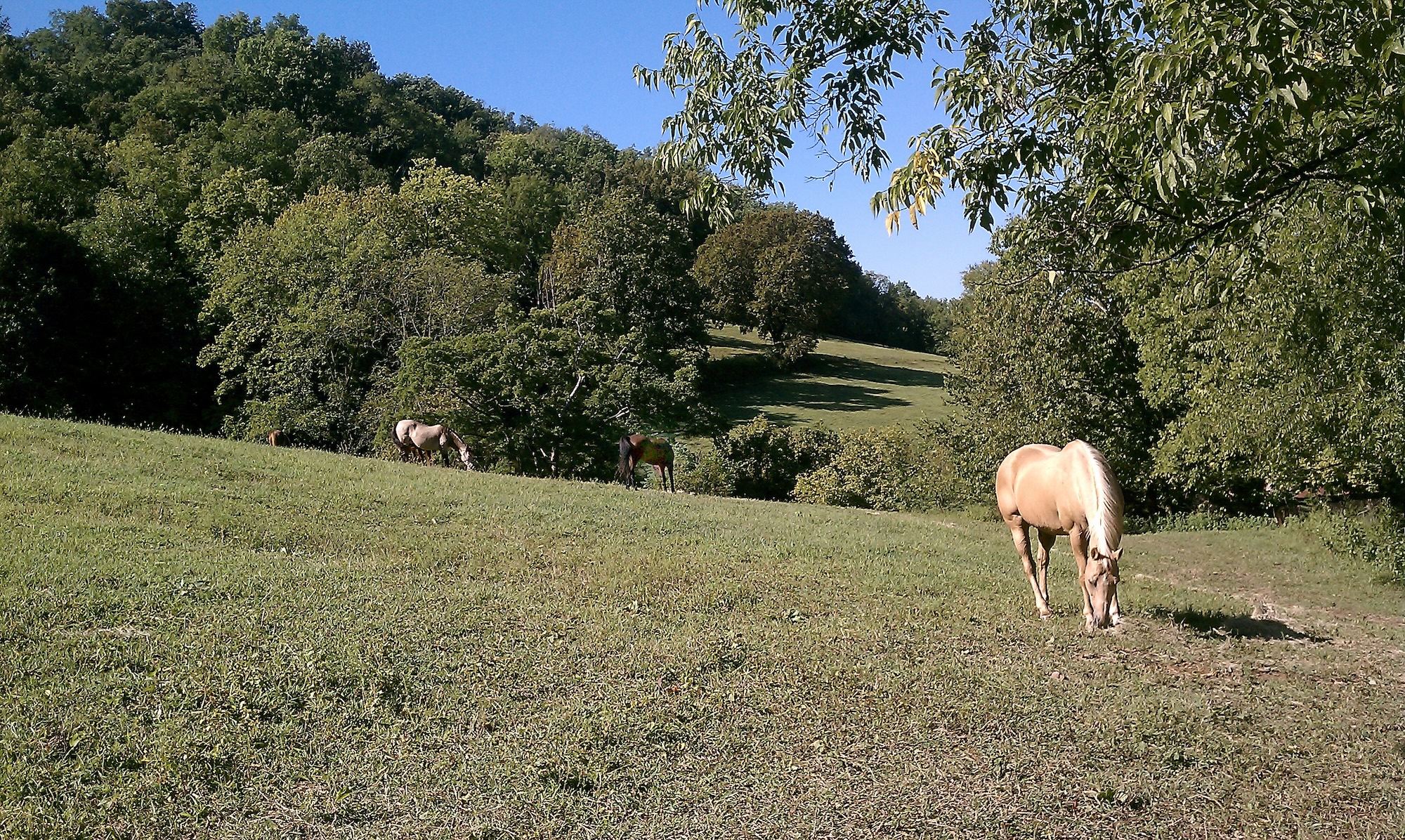
The following shots are a few looks at our hillside pasture, up close and personal. It’s hard to discern in these small photos, but each one contains at least some Bermuda, orchard, fescue, Dallis Grass and various orbs and un-named weeds.
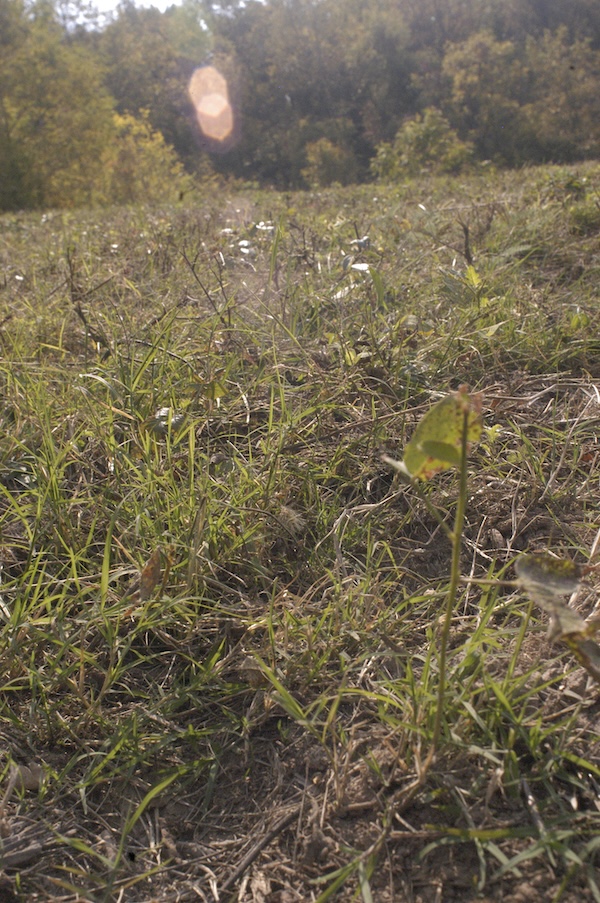
As I wrote this in October, our herd’s favorite delicacy was that flat seed of a weed that is covered in something like Velcro which sticks to anything that gets within yards of it. The horses come in with dozens of those awful things clumped in their forelocks, all over their faces, on their legs, everywhere! As I pull these pesky seeds off, the horses usually want to eat them out of my hand. Obviously there’s something there they need or want. If a horse is getting plenty of what he needs or wants, he simply will not eat something that’s bad for him. But if he’s hungry and something bad is the only choice he has, he will eat it.
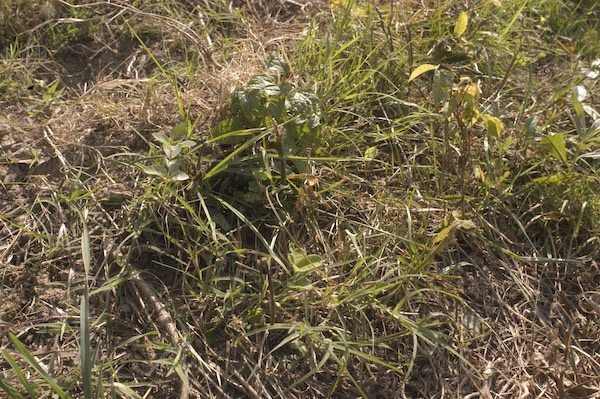
How many acres per horse? The only answer I know is: it depends. We’re at approximately 3.5 acres per horse. Last fall, when we arrived, just after we had bush hogged maybe a third of it that had been allowed to grow wild with virtually no grass, and before we had sewn any seed, I was worried that the pasture wouldn’t be large enough. But after sewing a bit of orchard and a lot of Bermuda this past spring and summer, there was still plenty of grass in October. I think we’re going to be fine. For cutting we follow Melanie Bowles’ philosophy at the Horses of Proud Spirit Sanctuary. Nothing ever shorter than 4”, grass never longer than 12”.
Our two pastures are both open to all the horses at all times. When we moved in, neither pasture had been fertilized for at least eight years. Of course, I didn’t have sense enough to ask that question before we bought the property, but for reasons I have never fully understood, once again God was taking care of us. The population was mostly weeds when we arrived, but we found that once it had been bush hogged, there was quite a bit of fescue, Johnson grass and Dallis grass underneath just begging for sunlight. You might recall that rain wasn’t an issue that first Fall. We planted maybe 50 pounds of Orchard at the tail end of the season. It was already too late for warm season Bermuda, but I didn’t know about the difference in sugar levels at that time, anyway.
By Spring, I was armed with research and when we started sewing, the mix was heavily skewed toward Bermuda. Maybe a third of it was orchard grass. And now all of it seems to be doing very well.
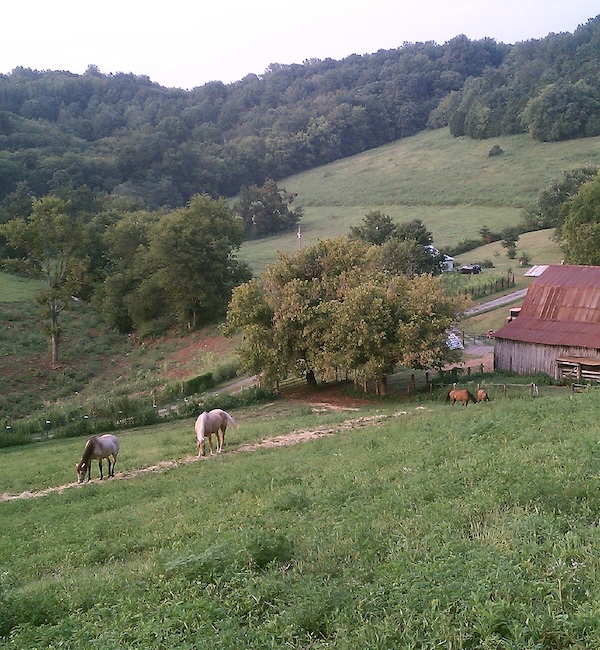
We continued to feed one bale of Bermuda hay a day during the hot season, split between morning and night, scattered over a long path through the western pasture to help enforce movement and to add diversity as we attempted to build our “wild horse meadow”. The spring-fed pond is located on the far eastern end of the east pasture, which helps a lot with movement. It’s their only water source.
So there it is. That’s what we’ve learned and what we’re doing. The logic of it all, as with so much of this journey, has left me wondering why in the world I didn’t see it before. But in any case, our horses are the beneficiaries. To change a “traditional” pasture to a “wild” pasture, I suspect, wouldn’t be as difficult or take as long as one might think. And it’s a whole lot easier to manage a messy pasture than to keep a pasture pristine. Stop all chemicals. Throw out (by hand) a lot of differing seeds trying to favor warm season grass or at least 50/50 with cool season grasses. Hike into the nearest woods and bring back some weeds, seeds of weeds, and brambles, and shrubs. Take the fences off your trees. And manage the pasture only by cutting. Grass does well with cutting, weeds do not. So if you cut with Melanie’s plan the weeds will not take over. They’ll just be a presence. Or so I’ve been told, and it seems to be working for us.
And please remember, the object of all this is to be able to leave your horses out, living like horses, around the clock, 24/7, without worry about the amount of sugar your horse might be taking in. Or what that sugar might be doing to the health of your horses. To be able to let the horses monitor and manage their own diet and lifestyle instead of us micro managing their entire life. This is not to say that certain supplements might not be needed to cover deficiencies, which requires testing the grasses, perhaps the soil, observing the horses, and filling in the holes. But definitely cut out all processed feeds, all feeds with grain (sugar), and, of course, all sweet feeds.
If you need added weight, consider maybe a tiny bit of alfalfa, or rice bran (we use rice bran). Our herd gets a small forage feed (Triple Crown Safe Starch) morning and night with a bit of rice bran (different for each horse) and a few supplements top dressed, which I believe will be tapered off over time. But that is yet another topic. This one was all about what you can do to a sugar-unfriendly pasture to give your horses the lifestyle and health they were genetically designed to live, the lifestyle they deserve. This September (2011) will mark two full years of our herd being out 24/7 with only the barn breezeway for occasional shelter, at their choice, not ours.
For your horse’s sake, please put the bugs back on the leaves.
Godspeed!
Published in The Horse’s Hoof Magazine, Issue 43, Summer 2011, originally titled, “High Desert Horses on Middle Tennessee Grasses, Part One (Learning How to Let Horses Graze Safely)”
Read the companion article: Joe Camp: Desert Horse Hooves Move to Tennessee
To learn all about Joe Camp’s California rocky dry hillside paddock paradise, please read: Spreading the Barefoot Word with Joe Camp
Epilogue:
I was heartbroken to hear the news that the great Joe Camp passed away in March 2024. While so many will remember Joe for his creation of the beloved Benji movies, we will always TREASURE what he did for the barefoot horse movement. His best-selling book, “The Soul of a Horse” (now in its 17th printing) was just the beginning of his mission to change the horse world – and he surely did. He cared deeply about developing a true relationship with his horses, as well as their lifestyle, diet, training and barefoot hooves. And he shared his journey with us all.
To enjoy a wealth of articles from Joe Camp, please visit his website: https://www.joecamp.info
Joe Camp’s best-selling book, “The Soul of a Horse” is now in its 17th printing, you can order on Amazon or anywhere books are sold.
Joe Camp’s smaller book, “Horses & Stress – Eliminating The Root Cause of Most Health, Hoof, and Behavior Problems” is also one of my most recommended books. You can order on Amazon or anywhere books are sold.
Please look up all of Joe Camp’s books on Amazon, available in paperback or Kindle. They are well worth collecting.
See the full content listing of all issues of The Horse’s Hoof Magazine! We also provide instructions on how to read the issues for free on Hoof Help Online.
For a detailed listing of all articles on The Horse’s Hoof website, please visit our Article Directory.