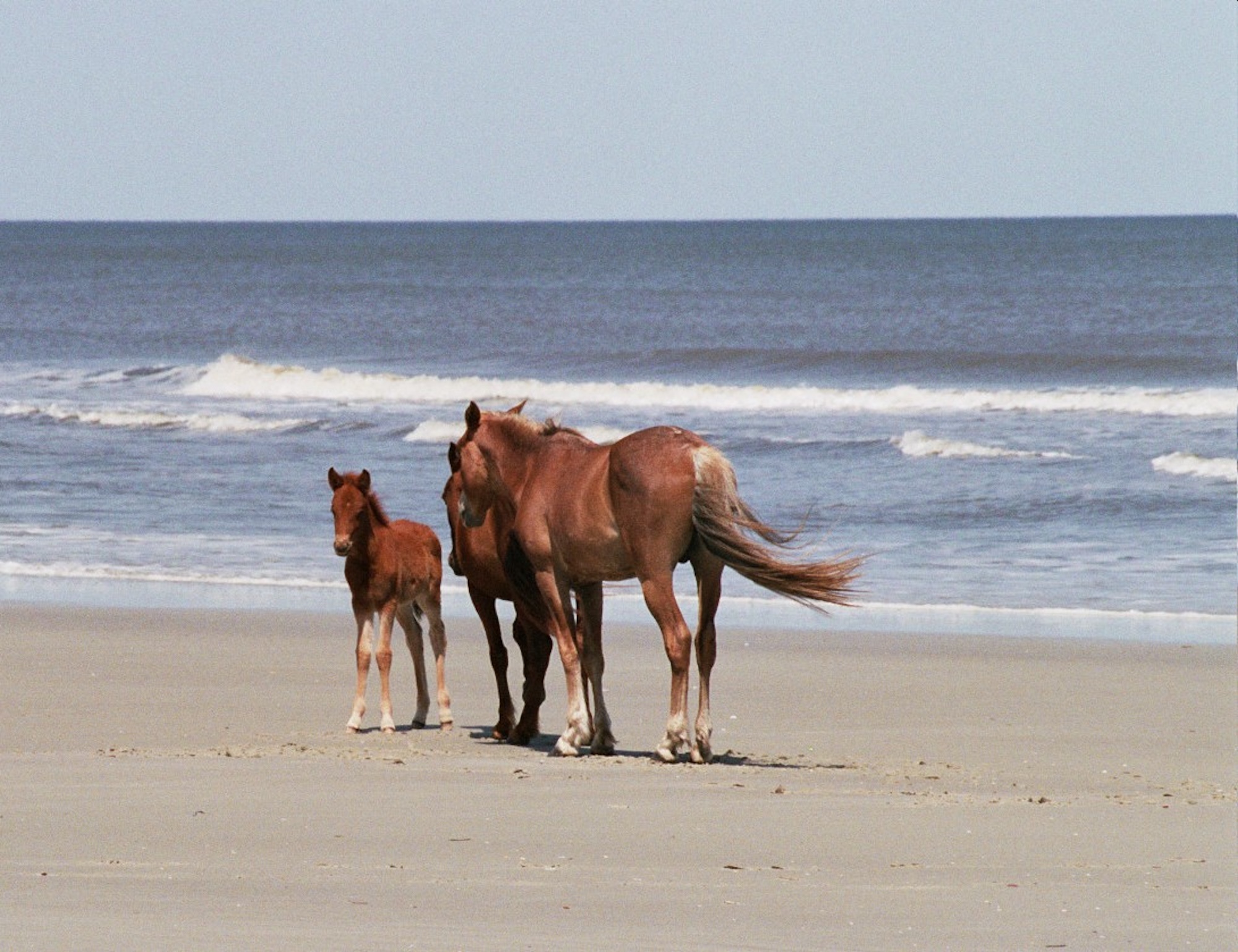
In April 2005, my two friends and colleagues, Derry McCormick and Steve Dick, and I headed down to Cumberland Island—a protected National seashore off the coast of Georgia. Our purpose was to take a look at the wild horses living there. Since the beginning of the modern “barefoot” movement, we had our doubts about the claims of some that wild horse feet, anywhere in the world, all look the same. In those early days, the “model” was exclusively centered around the feral horses in the high desert biomes studied by Jaime Jackson and presented in his landmark book, “The Natural Horse.” That vision of the “perfect” natural foot, that all horses should ultimately achieve if you’re “doing it right,” persists to this day.
Enter common sense. Those of us who developed busy hoof care practices with large client bases all over the United States and, indeed, the world, quickly realized that a singular view of what is a healthy, natural foot simply made no sense. To anyone with even a rudimentary understanding of the variability and adaptability of all things in nature, a “one form fits all” paradigm just is not reasonable. We who built our businesses in the southeastern regions of America, where the environment is wetter and most terrain is softer than the high desert biomes that produced the popular notion of “the model,” saw quite a difference in hoof form. In many cases, there was an outright resistance of the feet to become “the model,” no matter what we did. Yet the horses were perfectly sound. So, we decided to trek on out and see for ourselves whether or not the feet of populations in a very different biome mirrored those of the high desert horses.
All photos courtesy Cindy “Hawk” Sullivan.
The most obvious first stop on our journey to answer the question “What IS the wild model?” was the Eastern barrier islands, because the environment there would be as different from the high desert as we could imagine, and still have relatively easy access. So, we headed to Cumberland Island, off the coast of south Georgia. “Cumberland Island is 17.5 miles long and totals 36,415 acres, of which 16,850 are marsh, mud flats, and tidal creeks. It is well known for its sea turtles, wild turkeys, wild horses, armadillos, abundant shore birds, dune fields, maritime forests, salt marshes, and historic structures.”
We explored the southern third of the island and observed approximately 50 of the estimated 250 horses reported to be living there at the time.
Feral Horses of the Barrier Islands Cumberland Island, Georgia
Access to Cumberland Island is only by ferry. Transportation on the island is by rented bicycle, or on foot. The only vehicles on the island are used by park staff, the few residents living there and the staff of the one hotel on the island. Everyone else…you walk. (Readers can search online for a more detailed history of Cumberland Island.)
A brief lecture is given before ferry boarding, in which park personnel include a warning to visitors that, according to the horses, the island belongs to them. We were told specifically that the horses do not care about humans, and if they are coming down a trail, we should yield the right of way—because they will not. This we discovered to be true at our first stop, the ruins of Dungeness.
We heard the horses well before we saw them. It was the unmistakable echoing squeals and throaty roars of horses meeting, greeting and challenging one another. As we entered the grounds around the ruins, we observed a number of horses engaged in mutual grooming, sniffing, and squealing challenges. This was a bachelor band, and the largest grouping we saw during our trip.
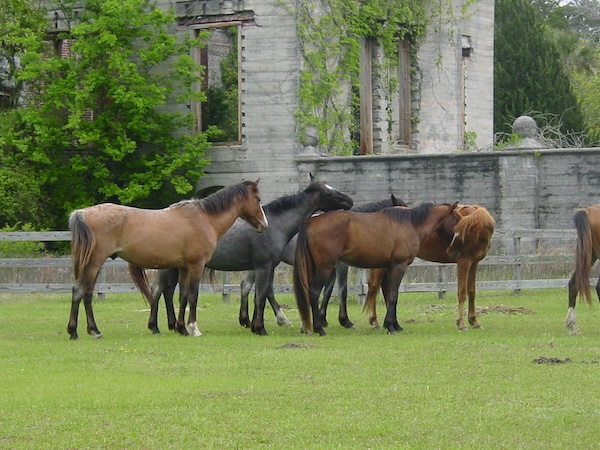
The Dungeness ruins are near the main ferry port and a popular stop for visitors to the island, so a human presence there is fairly constant. The horses were obviously used to people milling about, as they were unconcerned about our presence and went about their business as if we were not there. These boys gave us a lively display of stallion sparring and chases. The reason for the staff admonishment to “yield them the right of way” was quickly realized when two of these horses decided a game of “chase” was in order, and they raced about the ruins, nearly running over us, as if we were part of the landscape.
When the horses settled down, we were able to approach within a few yards without them moving away. Our reflexive reaction as hoof care professionals was, “Oooooh…they need a trim!”
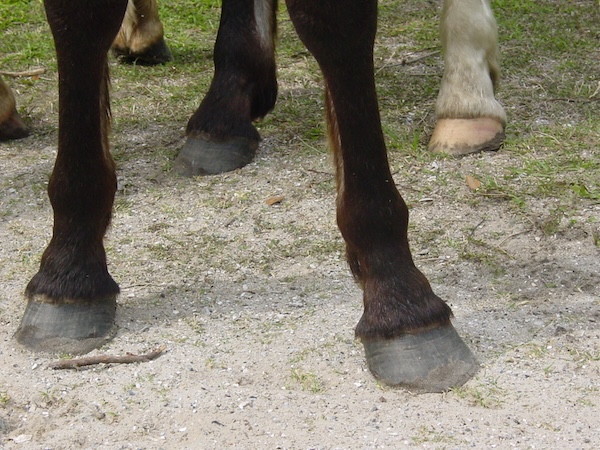
Since vehicles are restricted, there are no paved roads. These roads that the horses were running on and across are primarily composed of hard packed, crushed shell dredged from just off shore around the island. We even found an occasional shark tooth while walking along these roads. With such an abrasive surface, we would have expected well-worn feet, much like the western wild horses, and that their feet would be short and sporting the pronounced mustang roll we are all used to seeing; yet we saw some astonishingly long toes on some amazingly sound horses. As we moved on to explore other horses and other areas of the island, we would come to understand why their feet might look that way.
Herds
As mentioned, the bachelor band was, by far, the largest grouping of horses we encountered on the island. What dominated were very small groupings consisting of a harem stallion, one adult mare heavy in foal (or with a new foal at her side) and sometimes last year’s offspring along, as well. That was pretty much the case everywhere we went. There simply were none of what we have been taught to consider “typical” harem bands with a stallion, a number of mares and various offspring. It was as if every stallion was a “newbie,” having the one mare he “just” enticed away from her natal herd! Yet, it was evident that many of the stallion/mare pairings were aged adults. All groupings larger than “mom, dad and the kids” were bachelor bands, but those bands were very few.
Another interesting element we noticed was that every one of the new foals we observed was a filly. With males significantly outnumbering females in this part of the island, it was as if nature was trying to correct the imbalance by producing all girls in this new generation. Fascinating! It caused me to reflect back on some conversations long ago, between several of us who were early into the “natural hoof care” mind-set. We were discussing the observable ways that BLM interference by thinning herds would produce the opposite result. The mares would “crank up” production! If left alone, the availability (or lack) of sufficient food supply would result in fewer numbers in a given generation, and that mares could —and would—actually skip a year in bearing offspring, thereby naturally reducing overall population numbers. The idea that horses, or any other animal living harmoniously with its native environment, would out-strip it is an anthropomorphic fallacy. Unaware humans will do that, but nature uninterrupted, generally does not.
On that note, however, we must face the fact that nature is not all “happy, happy, joy, joy bliss,” as the movies would have us believe. It is stark and brutal to our sensibilities. Individuals die. Some are removed by predation, some by illness, and some starve. That’s the reality of it, but the net result is nature’s way of limiting populations without our “help.”
Given the absence of any natural predators capable of taking down a horse on this island, we wondered to ourselves why there would be such a disparity of genders. The year before our visit, the island had taken a pretty good hit by a hurricane, and there was evidence that the island was still in recovery. Could it just be a fluke that more mares were “taken out” by the storm? Maybe. However, several days into our trip, another possibility was revealed. Steve had occasion to strike up a conversation with an elderly man who worked on the ferry docks. He told us that, from time to time, people “cull” the horses. We were unable to verify it, but this old gentleman—who is native to the area—was very nonchalant and matter of fact in revealing that they (he did not say who “they” were) sometimes go in and shoot some of the horses, and, according to him, it’s not done with any mind to gender or keeping a balance. It’s not done to “manage” herd structure. It’s just done to reduce numbers. While we had no reason to doubt this man, we also cannot verify his story. We didn’t even get his name, and park officials certainly wouldn’t admit to it. All that the park employees would tell us is that the park service did no managing whatsoever of the horses. It would be interesting to investigate the veracity of the old man’s story.
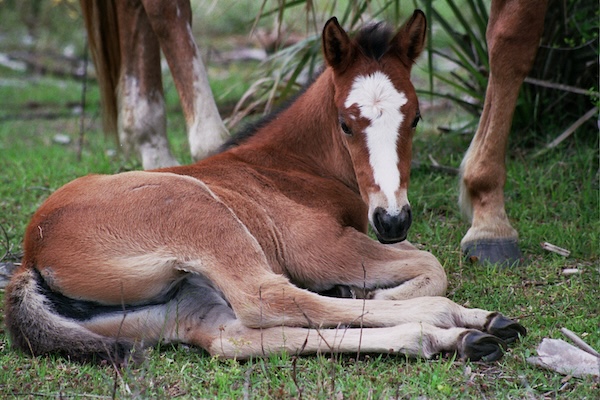
This little girl, like her parents, was unconcerned about us, as she lay down for a nap. We were able to get a great view of her beautiful little feet.
“Migration” on the Island
Obviously, barrier islands like Cumberland are closed environments, with limited space and limited food supplies. Those of us who have studied the natural hoof/horse for any length of time, know that diet plays a huge factor in hoof health. On this small island, how could these horses have enough space for each herd to have a “home range,” yet still find the necessary variety to rival what we see is available in the hundreds of miles of wide open space that the horses presented as “the model” enjoy?
As we explored various areas—woodlands, interior meadows, coastal marshes and seashore—we noticed that each family group migrated throughout the day to different areas where different types of forage could be found. They are just as territorial as horses in other biomes, but we believe that because the island is a relatively small land mass, these horses have developed a way of sharing resources. They must shift their “turf” throughout each day, so that every “herd” has access to sufficient nutritional variety. A family group or band might start out on the dunes, move to the forest, later on to the marshes, and so on, all within a 24 hour period. They seemed to be intent on defending whatever area they were in at the time, then (as if some silent bell went off) they would move on out and open the way for another group to come in. It appeared to be a cooperative adaptation that would assure all horses would have a period of time each day to forage on the different types of plants in each area.
Hoof Form and the Traction Factor
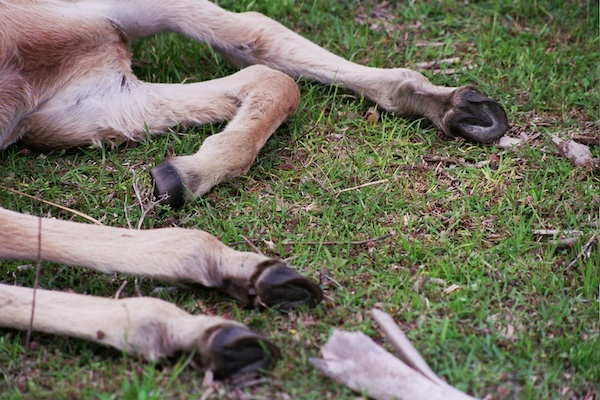
We wandered through the different areas of the island and observed the different groups of horses in each. What we noticed regarding hoof form, in the majority, were feet with long and intact walls extending well past the soles. Yet, of the ones we were able to look at fairly closely, they had tight whitelines, no true flares, healthy frogs, nice volar concavity and were sound. even the “boys” with the broken-off toes were all sound. The one soundness exception was a stallion we observed with a locking stifle.
Since the first horses we encountered were the bachelors at the ruins, a number of which had broken off hoof walls that, quite frankly, looked terrible to us, and the other horses had largely unblemished—albeit long—hoof walls, we pondered the purpose of such a hoof form.
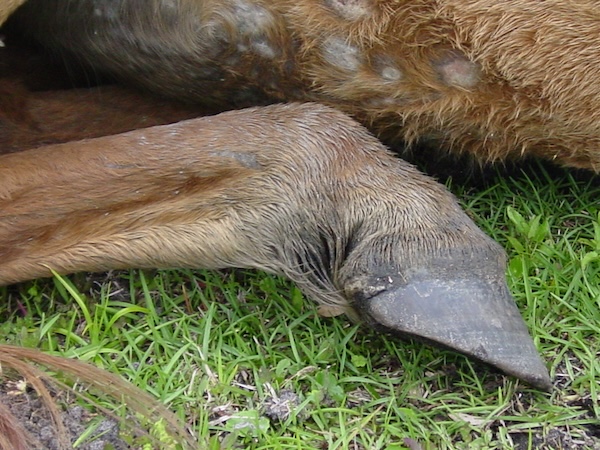
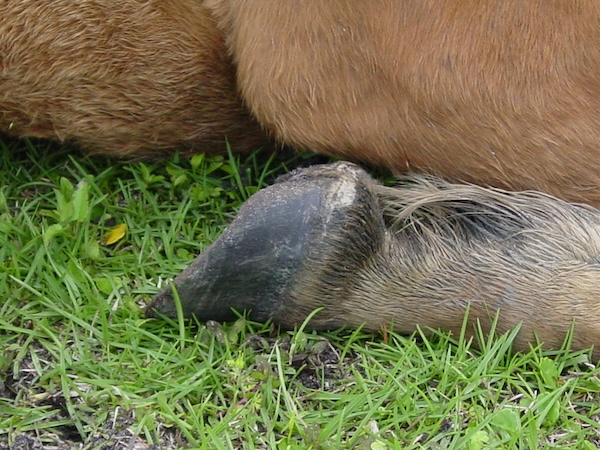
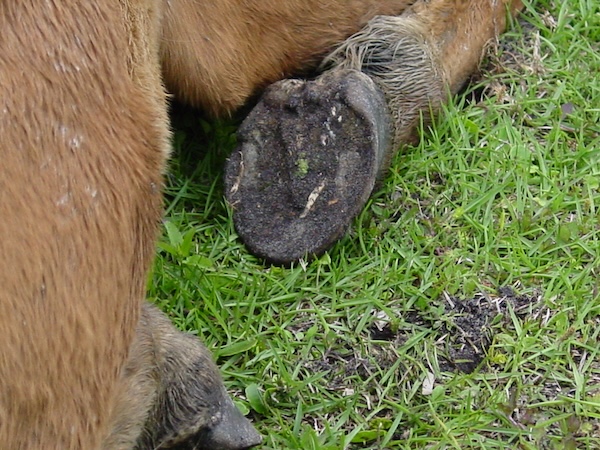
We understood well the concept that horses adapt to their environment, and the feet will reflect adaptations that were geared to survival. What would such feet offer, functionally, to these animals?
As mentioned earlier in this article, when we roamed to different areas of the island, we began to understand what might be the reason for the long hooves. With the exception of the roadways, most of the other areas the horses rotated into and out of were of terrain types that would either be neutral to long walls, or where those long walls would actually prove beneficial.
In the inland meadows and forested areas, the ground was soft, yet firm enough that the long hoof walls would seem to be neither a help, nor a hindrance.
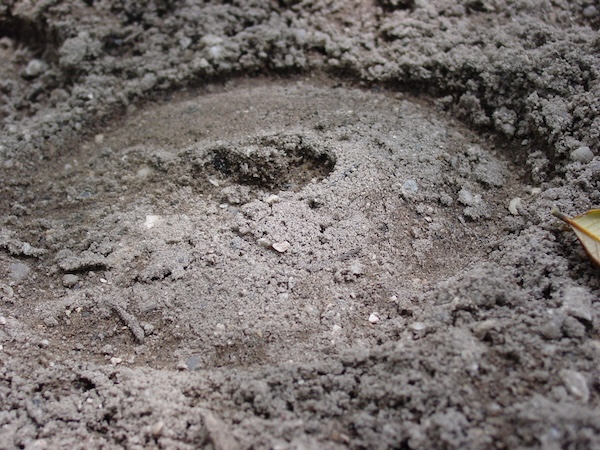
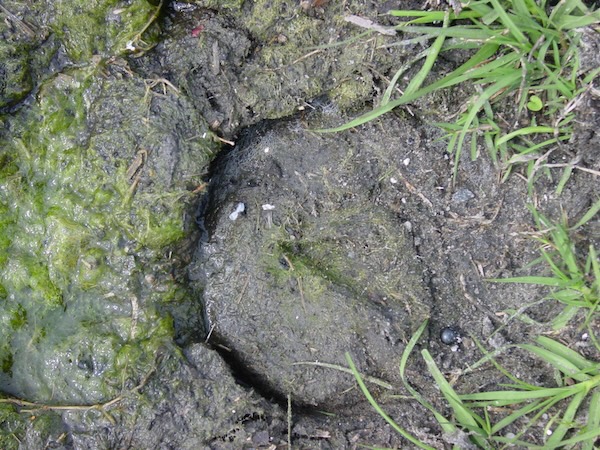
In the marsh areas, particularly the firm slick mud of the shores and shallows, longer walls would provide needed traction.
Having longer toes to “dig in” in the marsh areas would seem a helpful adaptation to the slick, wet surface of the marsh shores.
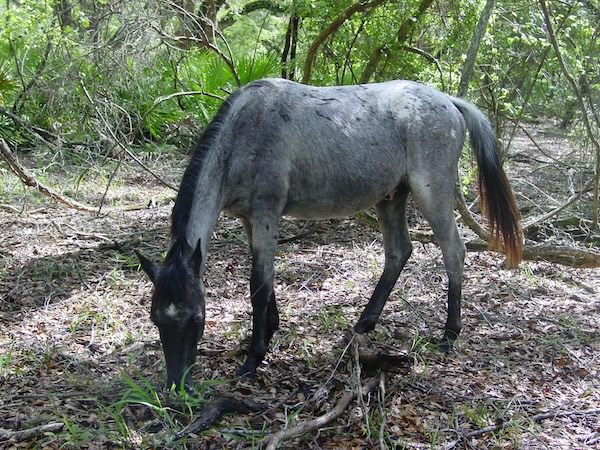
This young stallion forages in the woodland area.
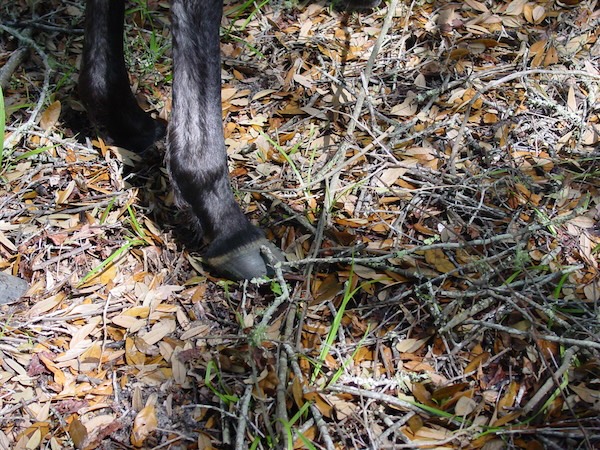
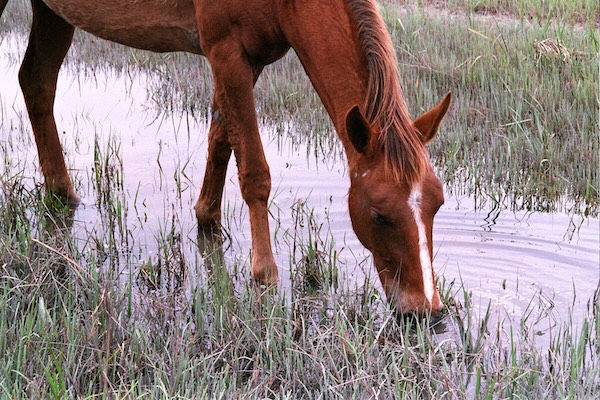
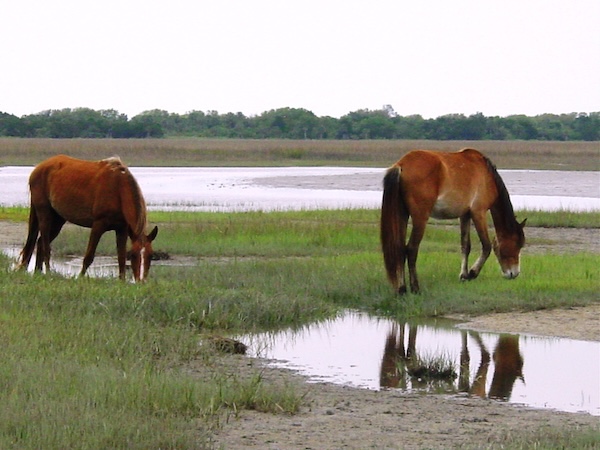
Photos above: the horses on the marsh shores. Below: a mud hoof print.
It was on these dunes that we felt that we truly understood why these horses all seemed to need long walls:
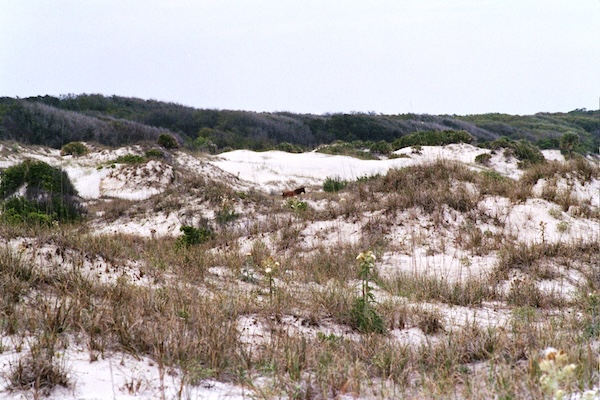
In my minimally treaded boots, I quickly found that I was working very hard to get virtually nowhere on the shifting sands of the dunes. It seemed like “one step forward, two steps back.” I was exhausted and had only made it a few yards when a horse flew by me, sand flying from its feet as it practically floated across the deep sand! These horses moved about these dunes with ease and, when needed, with surprising speed and agility. These “overgrown” walls created what amounted to a shovel on the end of each foot, allowing for exceptional traction.
It was evident by the end of our trip that the terrain in the vast majority of the areas on the island would seem to call for a high traction foot. Perhaps that is why these horses, from the aged to the very young, were sporting the unexpectedly long hoof form.
Yet one question lingered, as we thought back to when we first arrived on the island. Why were the bachelors sporting such damaged, broken walls? We surmise it is most likely because they were the only ones we observed in youthful exuberance, cavorting about and racing along the hard-packed shell roads. The family groups tended to mosey about, walking across the roads, and not expending energy unnecessarily. Thus, the feet of the mares, babies and the “harem” stallions were much less (or not at all) damaged.
So what are we to make of this? Is the high desert, Rocky Mountain hoof “the model” or not? My answer is, yes it is, and so is the barrier island foot presented here. It all depends on where the horses live, and how they need to adapt to give them the best chance for maximum survivability.
So what is the lesson for us? The same as for the horses—adaptability. We should never become so “herd bound” in our thinking that we become mired in a “one foot fits all” idea of how a natural horse hoof should look. “Think outside the box” is just as important for natural hoof devotees to remember, as it is for the conventional thinkers to learn. When we encounter a hoof form that doesn’t fit our notion of a “natural” foot, yet the core structures are solid and the horse is perfectly sound, there’s no need to berate ourselves by thinking we’re “doing it wrong.”
No doubt some readers will wonder, what are we to do with feet that are like the Cumberland horses, yet are in the domestic world. Should we just let them grow however they will? Let them break off and crack on their own? What’s the point of even trimming them, then? One figure head in the “barefoot movement” has dismissed out-of-hand the notion of adaptations such as the Cumberland horses for consideration, by contemptuously pointing to stalled horses as having “feet adapted to their environment.” Well, what about that? I submit that any reasonable person would agree that comparing a stalled domestic horse’s feet to a wild living population in any biome is akin to comparing apples to turnips.
As far as integrating information presented here into trimming approaches, I do not advocate that we just leave the long walls to break off on their own. What I do point out is that when we see sound feet that don’t fit the high desert model, we should give some thought to why the horse is growing them that way, then give thought to what the horse does for a living. An example would be the horse that performs in terrain where more traction is needed, such as eventers on turf. Leaving a bit more wall on the bare hoof can give much needed traction and derail the argument that such horses must be shod because they need the traction. This is why it is important to interview owners about their intended use for the horse, evaluate the living conditions at the barn, then develop your trimming strategy for that individual.
Additionally, we need to understand that wild populations move from one area to another over time, and their feet adapt along the way. Humans yank the horse out of its cushy pasture terrain, and trailer it to a rocky mountain trail in a matter of a few hours. It is not possible for the hooves to adapt to the sudden and extreme terrain change unless daily conditioning is done at home. Our job is to mimic natural wear to the best of our ability, and understanding that we have to find a middle ground. We want to trim for a hoof that will function well in rougher terrain, yet not totally rob the horse of the traction it needs to avoid pulling muscles or straining tendons by slip-sliding around at home. That might mean leaving a little more wall length on some (depending upon where they live), but keeping it short enough that the horse doesn’t have to “self-trim” by breaking it off and setting up formation of potentially nasty cracks.
The take away point for me is that when we see a different hoof form (that is not an obvious pathology), the first thought should be “What is the adaptation the horse is presenting?” We need only take a step back and remember the horses of Cumberland Island.
About the author: Cindy “Hawk” Sullivan is a professional hoof and horse care practitioner, clinician and instructor who has been involved in the modern “barefoot” movement since 1998. She is the owner of the web site www.TribeEquus.com, and co-founder of the Equine Sciences Academy www.equinesciencesacademy.com.
See the full content listing of all issues of The Horse’s Hoof Magazine! We also provide instructions on how to read the issues for free on Hoof Help Online.
For a detailed listing of all articles on The Horse’s Hoof website, please visit our Article Directory.