Editor’s note: Joe Camp, author of the national best seller The Soul of a Horse – Life Lessons from the Herd, and his wife Kathleen moved with their six horses from the high desert of southern California to the green hills of Tennessee in 2009. Joe was an outspoken advocate for barefoot horses and committed to keeping their herd out 24/7, even though they were being warned not to do so on the rich grasses of middle Tennessee. This article was adapted by Joe for The Horse’s Hoof from his book The Soul of a Horse Blogged – The Journey Continues, and provides inspiration for horse owners who wish to allow their horses to graze safely. All photos courtesy of Joe and Kathleen Camp.
What happens when Joe’s California desert horse hooves move to wet, grassy Tennessee?
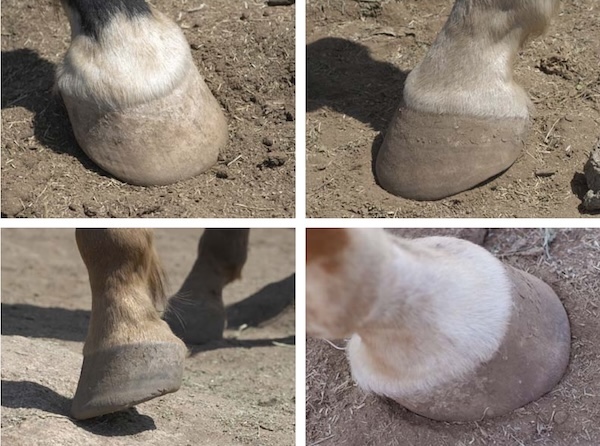
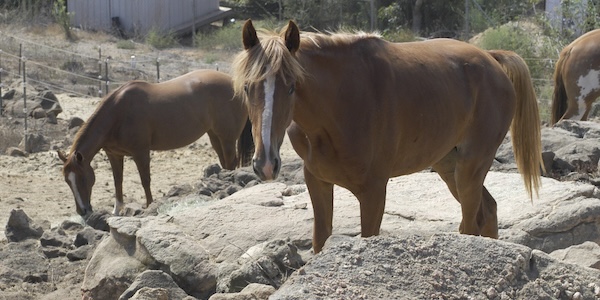
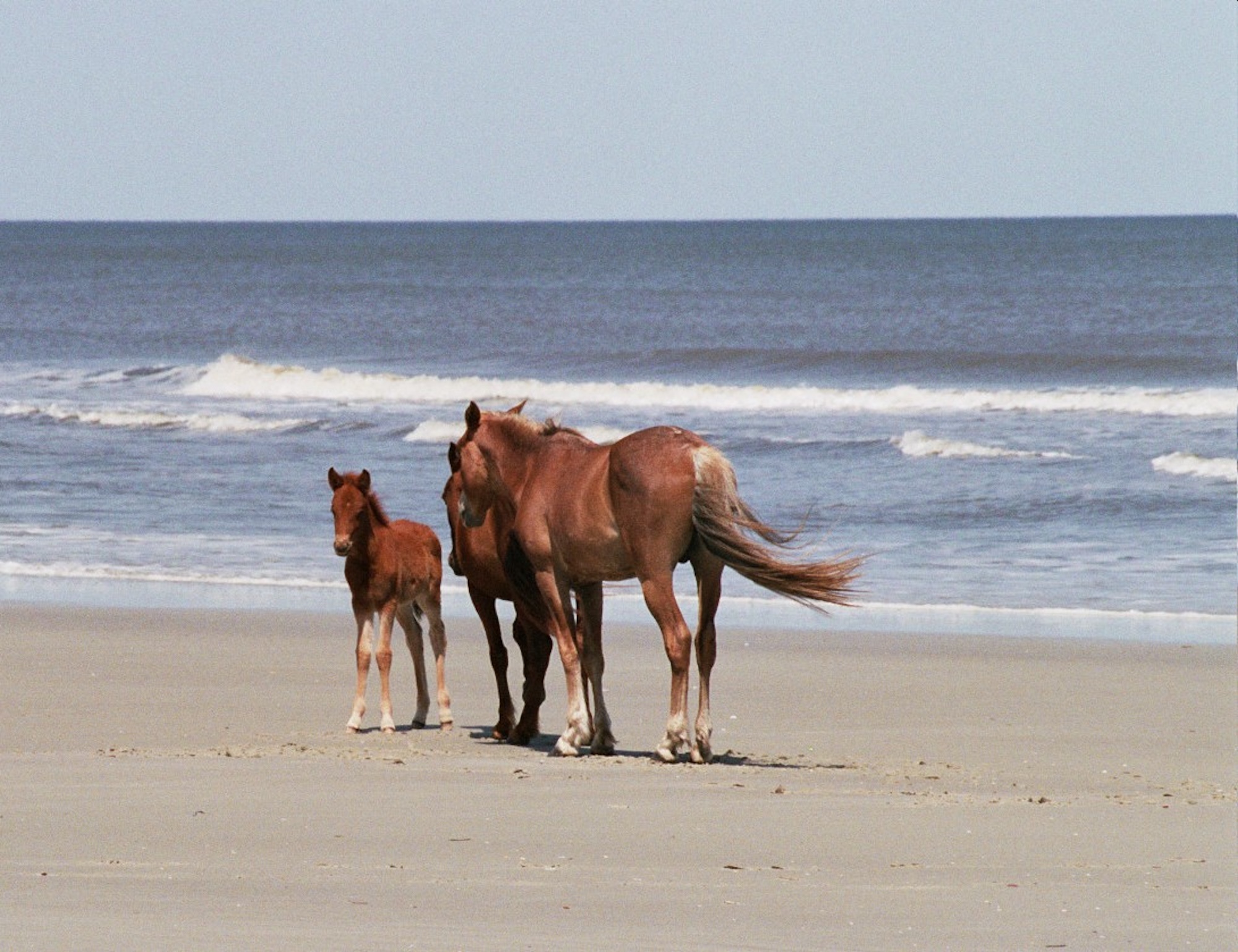
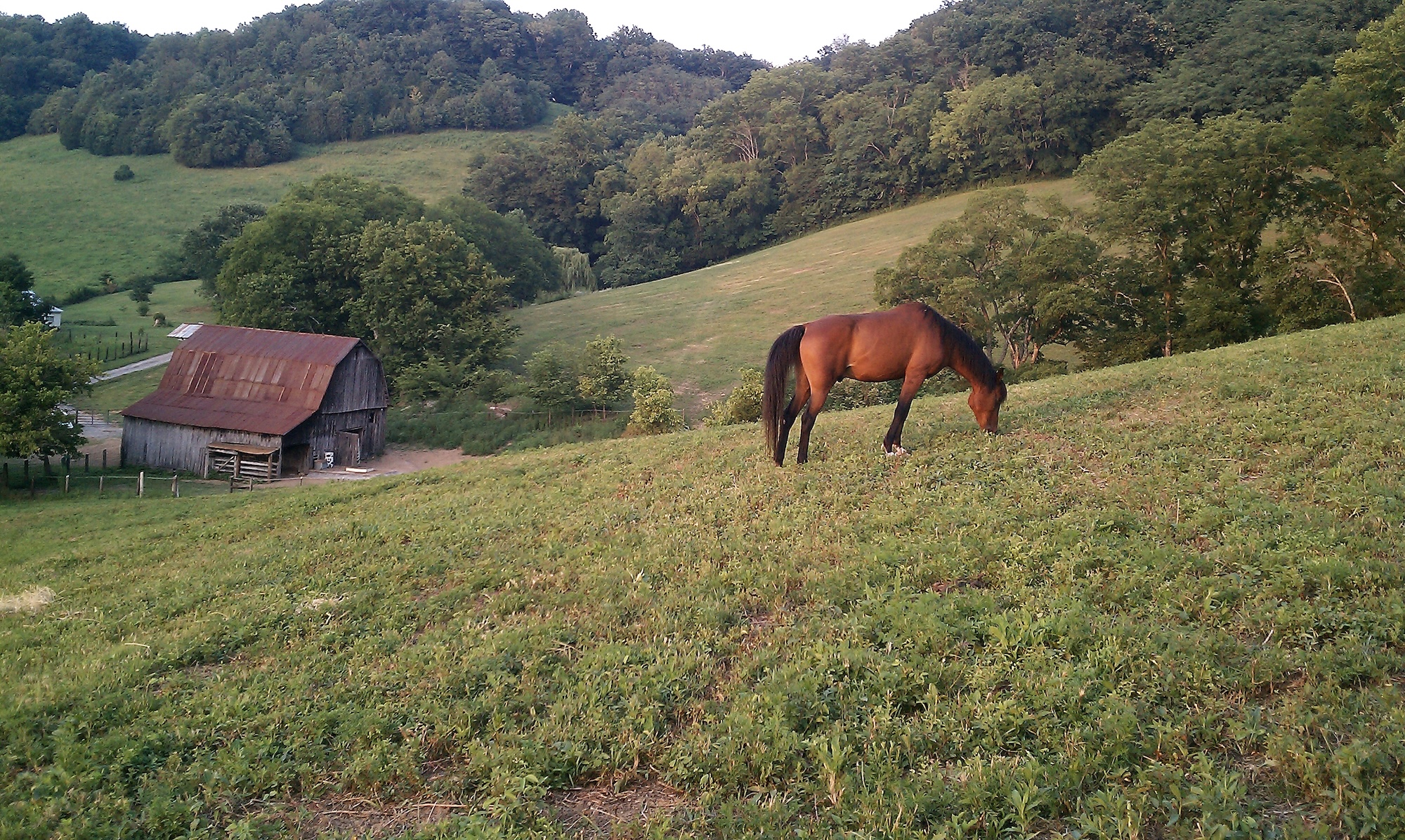
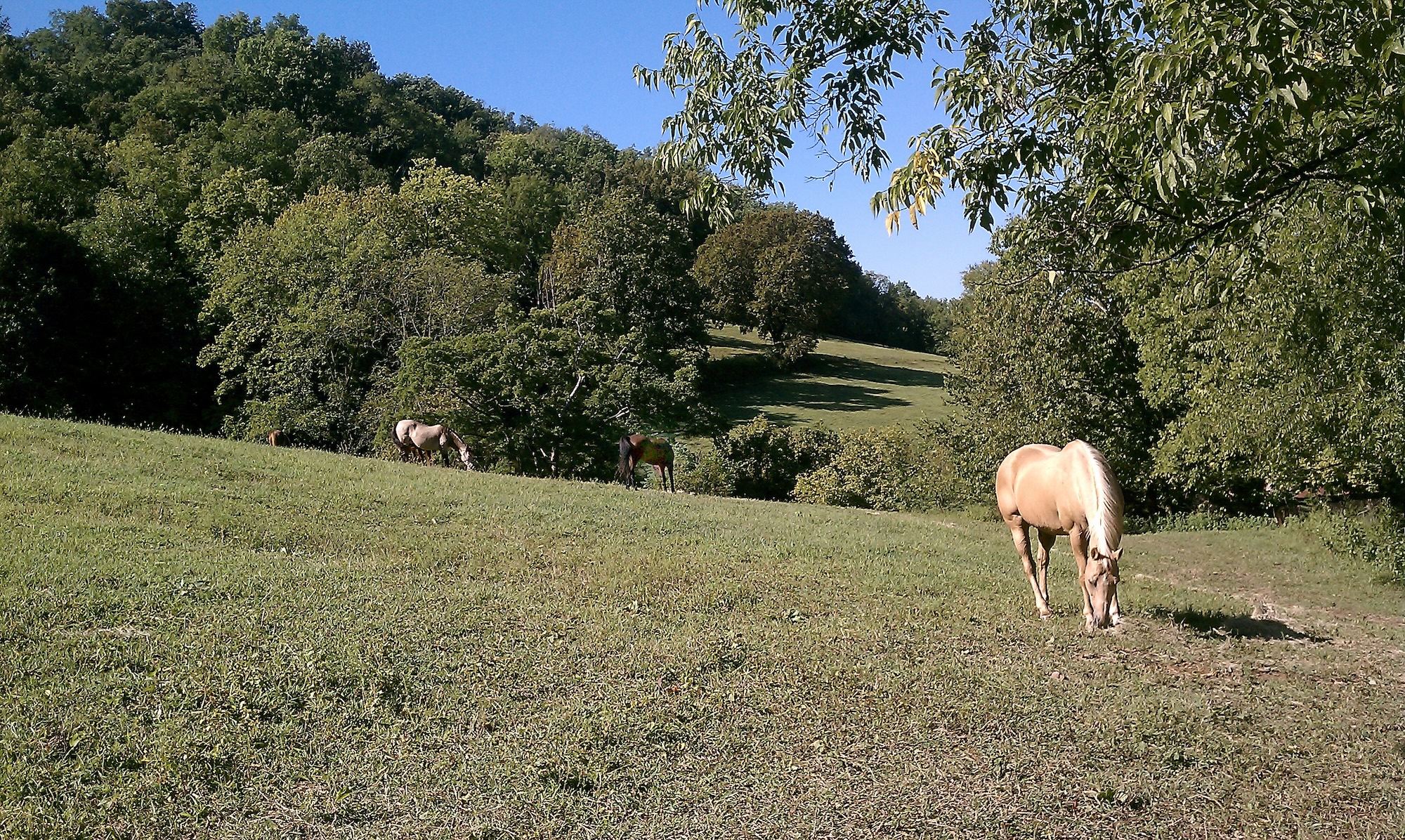
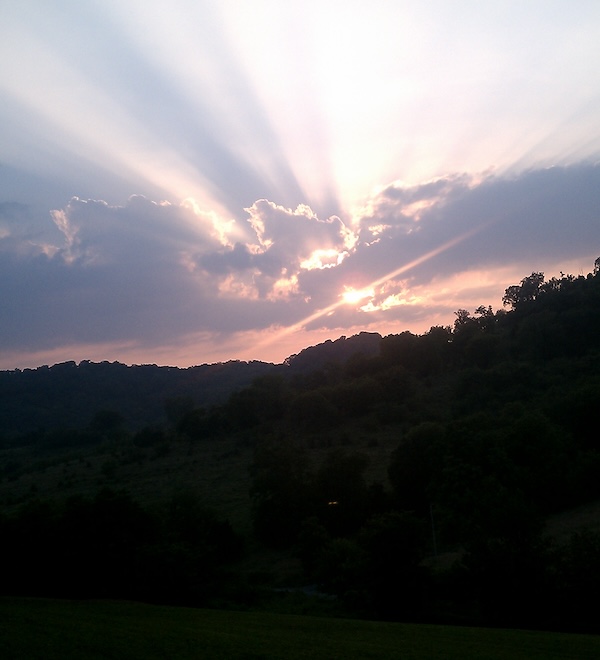
September 17, 2011 will mark the two-year anniversary of our southern California herd’s arrival in middle Tennessee, moving from the photo above to the one below.
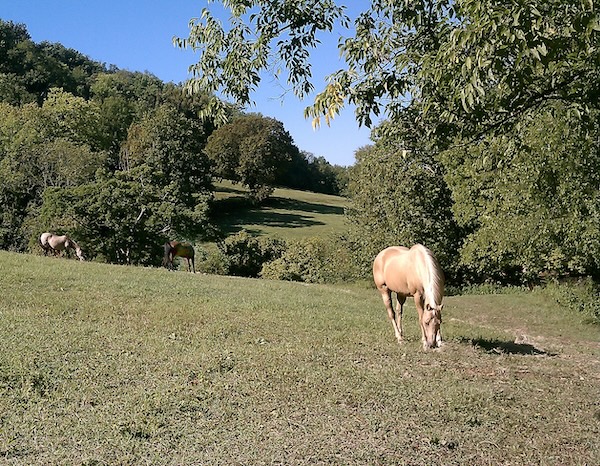
Quite a difference. Driven home by two years of record-setting mostly wet weather. We were worried sick about their feet, which were accustomed to the kind of terrain that horses are genetically designed to live on, like the Great Basin where they evolved for millions of years. Hard and rocky. Not unlike their southern California home. So feet were our number one concern. Especially when we discovered we were moving into the wettest fall on record in middle Tennessee and our horses would not even see dry ground for months, never mind hard and rocky. This would be followed by the worst winter in 25 years, the floodingest spring ever, the hottest summer on record, and the records are still falling as I write this.
Then warnings began to pour in from the locals: your horses cannot be out 24/7 on the rich, sugary grasses of middle Tennessee.
“You’ve just moved into Founder Valley!”
But we were determined to trust ourselves to figure it out. Determined that our herd would continue to live as natural a lifestyle as possible. The answers were found, as reported in my previous article for The Horse’s Hoof, by following the wild horse lifestyle of providing tons of unfertilized, un-genetically-mutated choices in the pasture including several species of native grasses cautiously divided between cool season (high sugar) grasses and warm season (low sugar) grasses, plus weeds, bushes, trees, brambles, berries, vines, etc., so the horses have enough choices to balance themselves. As opposed to the way many pastures here in Tennessee are managed, using a single species of cool season grass planted tight and close, like a carpet (which limits the horse’s movement) and chemically fertilized like crazy (also bad, especially the risk of horses ingesting excess levels of potassium). In other words, most of the pastures in this area offer no choices for the horses. No way for them to balance themselves, which they are thoroughly (and genetically) capable of doing if the choices are available.
Our herd of six were virtually maintaining their own feet in California. Dani Lloyd trimmed every 8-9 weeks, usually doing little more than light maintenance. But they were moving 8-9 miles a day on the kind of terrain pictured above. The trimming schedule changed in middle Tennessee.
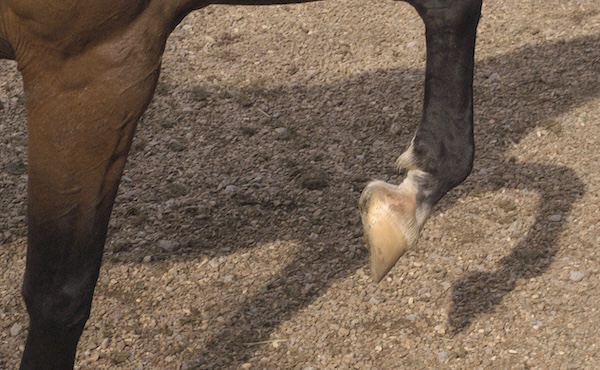
Mark Taylor is now trimming every six weeks and the hoof walls are always a bit long by trim day. We find ways to ensure a lot of movement every day but the terrain just doesn’t provide the wear and tear that they are genetically designed to get. Yet, because it takes 5,000 to 10,000 years to even begin to change the base genetics of any species, Mother Nature has no way of knowing our guys are not on Great Basin-like terrain. She is still growing that hoof as if they were. So we have to help them along with the trim, with movement, and with quite a bit of pea gravel in their well-traveled areas like the barn breezeway, the round pen, and around the pond where they drink.
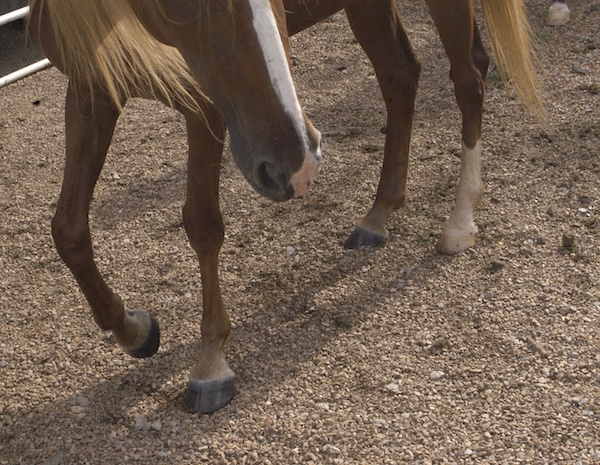
But with all this, even three to four weeks after a trim, our 24 hooves look for the world like they looked when forged on the southern California high-desert type of terrain.
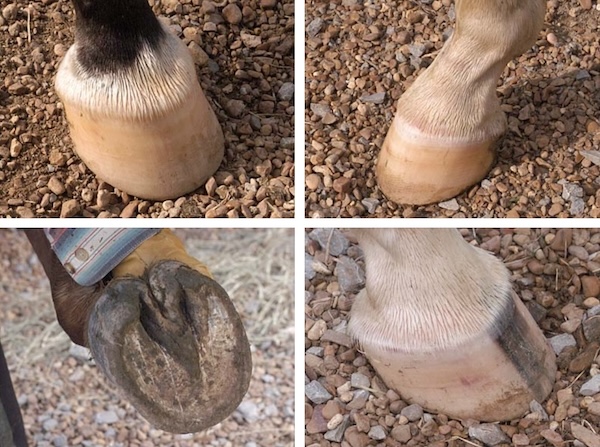
As mentioned before, the feet were my big concern with the move to Tennessee. But the feet turned out to be the least of our worries. Several things popped up that our high-desert herd had never experienced before. Not the least of which was that Kathleen’s and my “human-ness” always gets in the way. Like how difficult it is sometimes to stay on the horse’s end of the lead rope. To think about things from the horse’s perspective. Whether it relates to training or lifestyle.
I’ll never forget standing out in the rain one cold October day in California, soaked from head to foot because the rain wasn’t expected. The temperature was only in the mid-fifties, but to me, sopping wet, that was freezing.
I looked at our horses, heads down, dripping with water, and I just couldn’t stand it. I went for the halters and lead ropes and brought them into three covered stalls. The stalls were open, actually only half-covered, with one solid side facing the usual weather assault, but if we’d had a cozy barn with central heating and warm fuzzy pillows I’m sure I wouldn’t have hesitated to take them right in. Or cover them with blankets had there been any available.
It’s difficult for humans, especially when cold and wet, to understand that the horses do not feel like we do. Or eat like we do. Or react like we do. Or live like we do. We want to believe that the horse will always be better with human intervention. Human “help.” How can they possibly make it without us?
Later that month, I was wandering through a barn in northern Idaho. As I walked down the center aisle, I was struck by how clean it was. Pristine! When the owner happened by I said, “Do you never use this barn? It’s so clean.”
“Oh sure,” he said. “We use it for hay storage.”
“What about the horses?”
“They like to be outside.”
“Even in the winter? In the snow?”
“Yep.”
We were only twelve miles from the Canadian border. Winters are not warm here. I was amazed.
The owner walked around the barn to show me a lean-to he had built which was attached to the side of the structure. Just a roof, with divided but open stalls, to keep the horses separated when eating their supplements. They had free access to this shed, but never came into it except for the feed. Again, I was amazed. This ran so counter to everything I felt for my horses. We want to think of them as children, or big dogs, and treat them in the same manner.
They aren’t children, or big dogs.
Not even close.
What sometimes seems too simple for me to grasp is the fact that horses have been around for all those millions of years, evolving to survive as a prey species, and those evolved genetics are precisely the same for every horse on the planet, wild or domestic. Given the opportunity they can take care of themselves. They’re built to do it. If not, we would have never heard of the horse. They would’ve been extinct eons ago.
At both our former California home and the new one in middle Tennessee, we have worked hard to mimic the wild horse lifestyle as closely as possible. But it never fails. Just when I think I’ve got it, when I’m certain I understand the concept…WHAP!
Along comes a blow to test my faith.
Last September, Mariah quite suddenly went dead lame in her right front foot. With a pounding digital pulse. Couldn’t put any weight on it al all. An abscess! Apparently a bad one.
Fear rushed in and faith went right out the window.
It could’ve happened a few days earlier, before Kathleen and the twins returned to California to dig in for their last high school year. But it didn’t. No, it had to be while I was home alone. With no one to help, or soothe, or listen. I was frozen in place.
Freaked out.
Tharn!
I love that word from Watership Down. It’s rabbit-speak, and there is simply no English equivalent. It’s what happens when a rabbit gets caught in the headlights and is so suddenly petrified that he can neither move nor think.
I was tharn. Our vast experience with horses – almost 5 years now – had never shown us an abscess. I was told gory stories of digging out all this gross-looking stuff with a knife and soaking the horse’s hoof several times a day. High doses of antibiotics. And all the terrible things that can happen if it’s not properly cared for. I was so tempted to violate my firm beliefs, my faith in Mariah’s systems and the wild horse lifestyle, and lock her up because she was obviously in a great deal of pain trying to walk and keep up with the herd. But keep up she did, wherever they went. It was painful to watch. I was told the vet should come and dig it out.
At someone’s advice, I tried soaking her foot in Epsom salts. But she quickly grew tired and annoyed with keeping her foot in a tub for fifteen minutes at a time and finally she said enough!
And: Where’s my herd?!
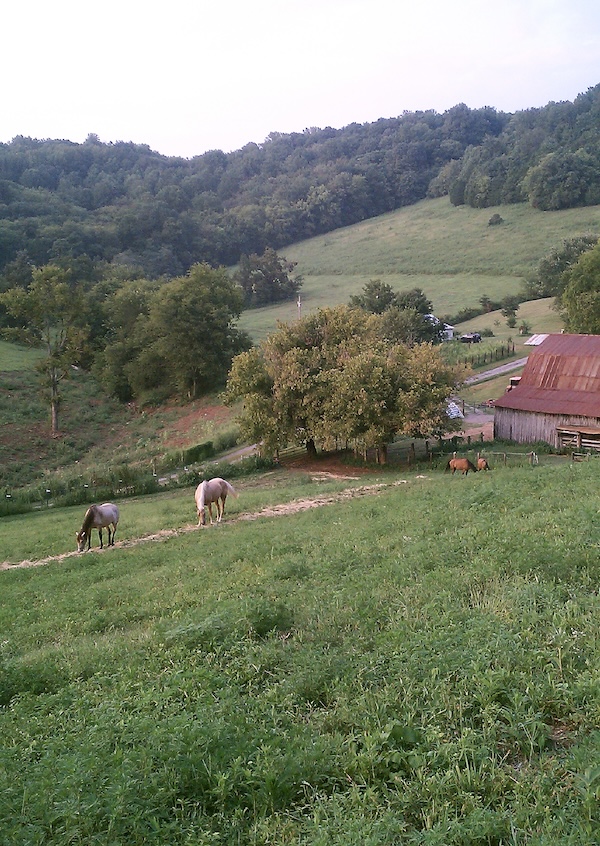
Determined, she found them, and with each step seemingly excruciating, she followed them off to the grove (she’s last in the photo above). Deep down I of course knew that movement meant blood circulation and circulation meant healing but it was buried too deep for me to find and take comfort in at the moment. But remember this please: stalling a horse with such a condition is exactly the wrong thing to do.
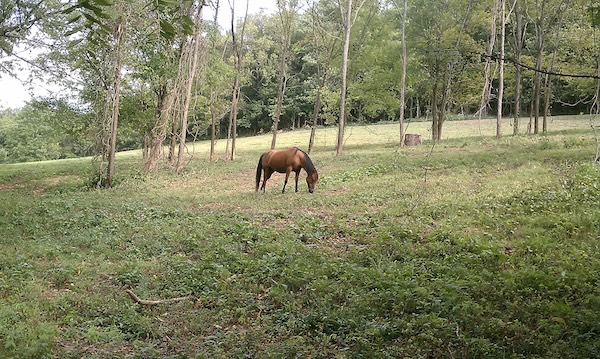
Mariah followed the herd all the way to the grove on the far end of the western pasture (above), between a quarter of a mile and half a mile away from the group photo above. Here she is surrounded by the herd, all just out of frame. With a long walk back to the barn.
I had to quit watching her move. It hurt me too much.
“Get a soaking boot. You have to soak,” someone said.
I made several phone calls and went out and bought a soaking boot.
It was never used.
When I arrived back at the house with the boot, there was an email waiting from Yvonne Welz, the amazing editor of this publication. She said: “Joe, when a horse has healthy hooves, abscesses are often here today and gone tomorrow! Just not a big deal. Yes, when the hoof has good blood circulation and lots of movement, the body just absorbs the problem area. Why do abscesses happen in healthy horses? Some sort of trauma or environmental cause, usually.“
Natalie Cruz of Shoe Free Performance Horses went a step further: “The vets won’t like this but abscesses will heal themselves. The best thing you can do for your horse is give it a couple of tablets of bute a day for a week or so and baby the horse a bit for your own peace of mind. Keep the horse turned out so it can move, which increases blood flow so the abscess either blows out or disintegrates inside the hoof. But check to make sure the horse was not kicked or otherwise injured, of course. If not, and the horse is suddenly dead lame on one hoof, it is usually an abscess. Take a couple of aspirin for your own headache and wait it out. But don’t allow anyone to dig it out! This is counterproductive to healing and can actually introduce bacteria into the hoof and cause problems! No need to wrap the hoof either. It just annoys the horse and doesn’t help its healing one iota. So drink a glass of wine and prop your own foot up instead. 🙂 Some drawing products like Epsoms salt may help a little bit, though I don’t use any of them.“
I had barely finished reading these when suddenly Mariah was better. Limping, but putting weight on the hoof. The next morning, she was walking fine. A day later, she was cantering down our steep hill with the herd racing to the barn for breakfast.
A few months ago, we had watched an abscess on Skeeter’s belly (caused by an allergic reaction) slowly disappear as the body dissolved it. Likewise my tharn-ness began to dissolve away leaving an embarrassed logic. Of course, it’s the blood circulation that does the dissolving. So why shouldn’t Mariah’s body do it’s job. She has terrific circulation in her feet because she wears no shoes. She gets tons of movement which increases circulation even more. Her diet is good. And her body is working as it’s designed to work.
The verse Oh ye of little faith came to mind.
Unfortunately appropriate.
The lesson? Nobody says it better than Rick Lamb: Give them as natural a life as possible. Then get out of the way.
Anybody want to buy fifteen pounds of Epson Salt?
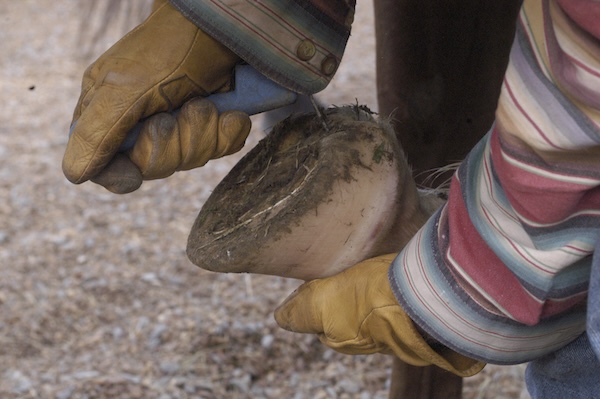
Throughout these two years, allergy problems from fauna the California herd had never seen before have probably been the biggest issue. More so last year than this year, so the immune systems are getting a handle on it all. Cash had a ligament pull from sliding down the hill in the snow. There have been a few pricks from thorny brambles allowed to grow too tall. All adding to the learning experience. But although the feet were my biggest concern when we headed to Tennessee, and although we’ve been through almost two full years of record-setting weather, our herd’s feet have been terrific.
We were handed yet another lesson this past Spring, because like so many humans hung up with human concepts, we brought the herd through the winter at their normal weight, upping rice bran portions to be sure they didn’t get too “skinny and unhealthy”. The problem with that contorted logic is that horses in the wild will naturally thin down as winter wears on. And they evolved to do so because, of course, the forage is more sparse in the winter, but also they can handle those “rich Spring grasses” much better when they burst into Spring nice and lean.
We didn’t see this issue the first Spring because they had been here only about six months and were apparently still adjusting to the move. But this their second year, when the Spring grasses began to emerge – cool season higher sugar grasses always emerge before the warm season grasses containing less sugar – the horses all blimped up pretty good. We missed it in the beginning because we are with them every day, so I’m really thankful that Mark Taylor, our hoof specialist, was coming every six weeks. He spotted the extra weight immediately and we slowly but methodically cut way back on the rice bran (which is the only weight maintenance supplement they receive).
This fall we’ll let them go into winter with a decent weight, but in January we’ll start cutting back on the rice bran – watching and judging as we go – so they’ll hit the Spring grass season lean and mean so to speak, and thereby able to handle the higher sugars with less effort. Just like in the wild.
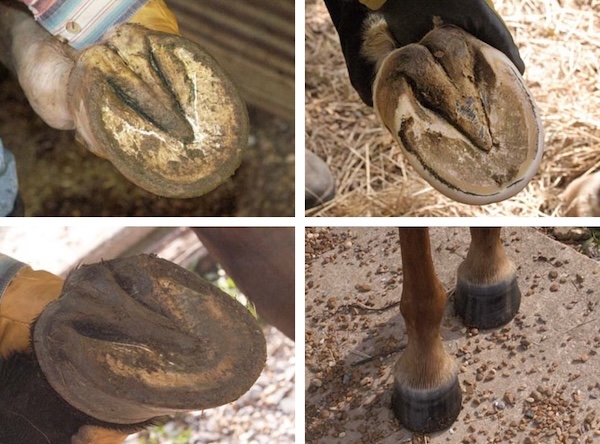
So here we are marking the two-year anniversary of our guys and gals being out 24/7 on the “rich grasses of middle Tennessee.” They’re a happy healthy bunch, and Kathleen and I are mighty proud parents. As we stress in all of our books, please don’t take someone else’s word for how you should be caring for your horses, just because that’s the way it’s always been done. Do the research yourself, dig out the answers, and don’t stop asking questions until the answers begin to make sense.
Discovering the mysteries of the horse will be a never-ending journey, but the rewards are an elixir. Nothing can make you feel better than doing something good for another being. Not cars. Not houses. Not facelifts. Not blue ribbons or trophies. And there is nothing more important in life than love. Not money. Not status. Not winning. This is the synthesis of our books and why each one came into being.
There are many who teach relationship, riding, and training with principles of natural horsemanship. Others support the benefits of going barefoot with the wild horse trim. Still others write that your horse should eat from the ground, and live without clothes and coverings. Some promote day and night turnout, where your horses can move around continuously. I’ve found none who advocate the essentials of a wild horse meadow in their pastures. And few have explored how dramatically one without the other can affect the horse and his wellbeing. Few have put it all together into a single philosophy, a unified voice, a complete lifestyle change for the domesticated horse. When I gave Cash the choice of choice and he chose to trust me, he left me with no alternative. No longer could it be what I wanted, but rather what he needed. What fifty-two million years of genetics demanded for his long, healthy, and happy life.
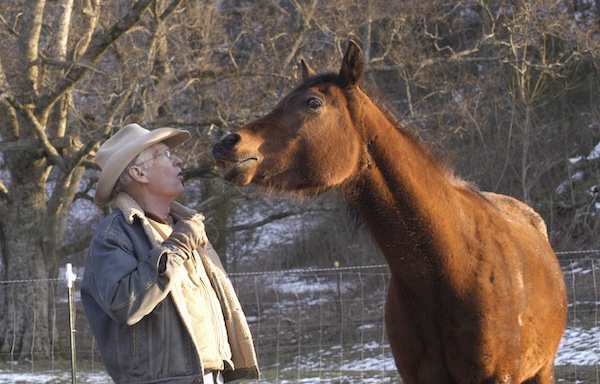
So here we are. Six happy, healthy horses, all very well adjusted and loving their natural life… as we continue to receive our life lessons from each and every one. We are replenished daily, hourly, by scenes like the ones above and below. On a recent evening, Kathleen and I sat on the porch with a glass of wine watching the herd, and talking. “I know in my heart that the philosophy is correct,” she said. “That our horses are living the life they should be living, and because of that they should be able to take care of themselves.” She paused for a moment, then added, “But it surely feels good to see two years come to an end and be able to witness the hard cold proof of it all.” I smiled, teared up a bit, and said simply, “Thank you God.”
Published in The Horse’s Hoof Magazine, Issue 44, Fall 2011, originally titled, “High Desert Horses on Middle Tennessee Grasses, Part Two”
Read the companion article: Joe Camp: Learning How to Let Horses Graze Safely
To learn all about Joe Camp’s California rocky dry hillside paddock paradise, please read: Spreading the Barefoot Word with Joe Camp
Epilogue:
I was heartbroken to hear the news that the great Joe Camp passed away in March 2024. While so many will remember Joe for his creation of the beloved Benji movies, we will always TREASURE what he did for the barefoot horse movement. His best-selling book, “The Soul of a Horse” (now in its 17th printing) was just the beginning of his mission to change the horse world – and he surely did. He cared deeply about developing a true relationship with his horses, as well as their lifestyle, diet, training and barefoot hooves. And he shared his journey with us all.
To enjoy a wealth of articles from Joe Camp, please visit his website: https://www.joecamp.info
Joe Camp’s best-selling book, “The Soul of a Horse” is now in its 17th printing, you can order on Amazon or anywhere books are sold.
Joe Camp’s smaller book, “Horses & Stress – Eliminating The Root Cause of Most Health, Hoof, and Behavior Problems” is also one of my most recommended books. You can order on Amazon or anywhere books are sold.
Please look up all of Joe Camp’s books on Amazon, available in paperback or Kindle. They are well worth collecting.
See the full content listing of all issues of The Horse’s Hoof Magazine! We also provide instructions on how to read the issues for free on Hoof Help Online.
For a detailed listing of all articles on The Horse’s Hoof website, please visit our Article Directory.